Transcript
Shelob's Lair
Cirith Ungol, the Spider's Pass Into Mordor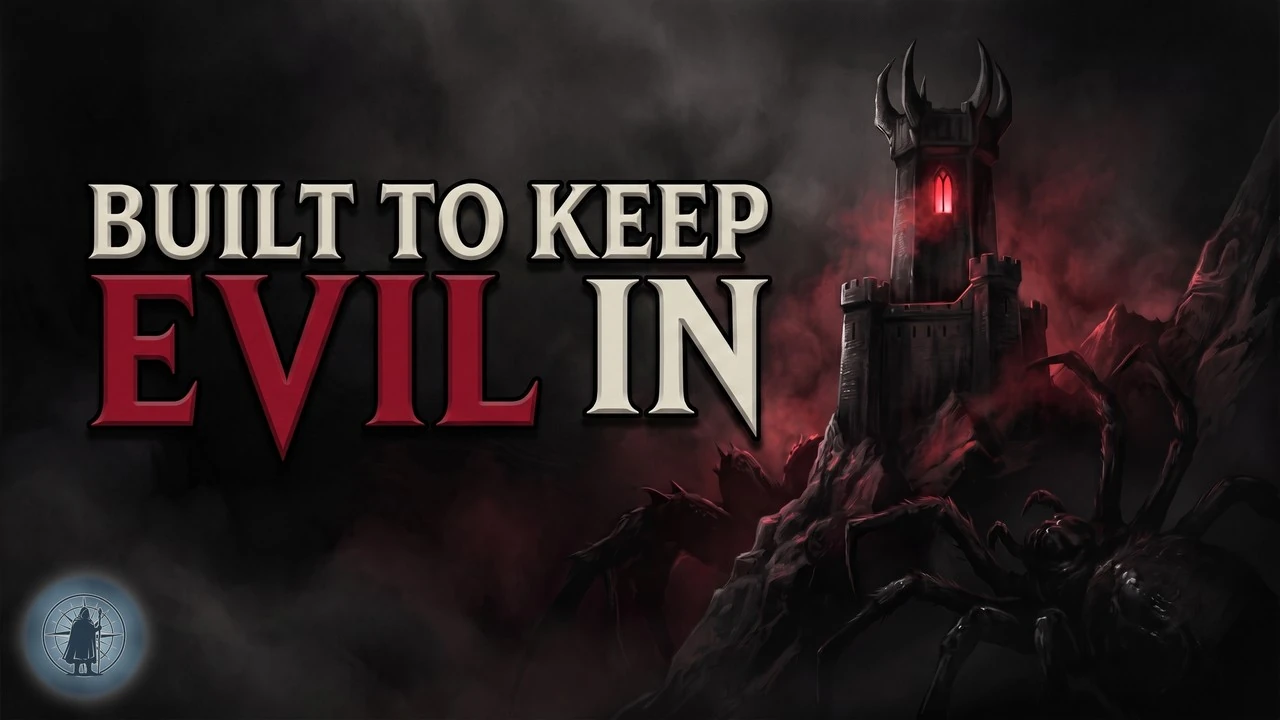 Watch the episode
Shelob's Lair: Cirith Ungol, the Spider's Pass Into Mordor | Tolkien Explained
Watch the episode
Shelob's Lair: Cirith Ungol, the Spider's Pass Into Mordor | Tolkien Explained
SECTION: The Cleft of the Spider
"There is another way. O yes indeed there is. Another way, darker, more difficult to find, more secret."
That's Gollum, standing in front of the Black Gate of Mordor in March of the year 3019 of the Third Age. Frodo and Sam have walked to the Morannon, looked at it, and worked out that they can't get in. Now Gollum is telling them that there's a back door.
Gollum describes it.
"A little path leading up into the mountains; and then a stair, a narrow stair, O yes, very long and narrow. And then more stairs. And then a tunnel, a dark tunnel; and at last a little cleft, and a path high above the main pass."
Path. Stair. Stair. Tunnel. Cleft. That's the route in order. All the pieces turn out to be exactly where Gollum says they are. Gollum is telling the truth about the geography. But he's lying about everything else.
The mountains he's pointing at are the Ephel Dúath - Sindarin for "fence of shadow". That's a fair job title for a mountain range whose whole purpose is to be Mordor's western wall. Somewhere along that wall there's a notch, and the notch has a name.
Cirith Ungol.
Cirith means "cleft", from a root that means "to cut" - the same word turns up in Cirith Gorgor, the haunted pass at the Black Gate. Ungol means "spider".
So the place is called the Cleft of the Spider. It says so on the label, in Elvish. For most of the journey nobody will dare to say it out loud.
The climb starts off the main road. Out of Ithilien, four ways meet at the Cross-roads, and the road bends east into the Morgul Vale under the walls of Minas Morgul. Before it reaches that gate, a side path breaks off and goes up.
The first flight is the Straight Stair. It's cut down between two walls of rock, and it's "almost as steep as a ladder". The steps are narrow and unevenly spaced, worn smooth in places, cracked and broken in others. Some snap under too much weight.
The second flight is the Winding Stair. The Winding Stair has the opposite problem. It doesn't set into the mountain at all. The cliff-face sets back, and the stairway snakes in and out across open rock with the drop on one side.
Above the second flight there's a tunnel, and above the tunnel a cleft.
Past the cleft we get to the thing Gollum never quite gets around to describing.
The Tower of Cirith Ungol sits on a shelf of the mountain-wall. Its eastern face stands up in three great tiers, one above another, getting smaller as they rise, with sheer sides of what Tolkien calls "cunning masonry". Its back is set against a cliff, and it juts out in pointed bastions. Around the lowest tier runs a battlemented wall, and when Sam Gamgee eventually stands on the upper path and looks down at it, that wall is two hundred feet below him. The gate is on the south-eastern side, and it opens onto a broad road.
There's one more thing about this climb. Getting to the top of it doesn't get you into Mordor.
Past the cleft the land drops into a dry trough, and on the far side of the trough there's a second ridge - the Morgai, "the black fence", lower than the Ephel Dúath and running parallel with it. Two walls, with a ditch between them. Frodo and Sam get through the pass and find themselves in the ditch. From there, Mount Doom is still "forty miles at least" away, its head wrapped in cloud.
So the cleft isn't the finish line so much as the rough halfway mark.
SECTION: Gondor Ran Out of Men
So Sauron didn't build this tower. But somebody did.
Tolkien gives tells us who in The Return of the King.
"It was indeed one of the works of Gondor long ago, an eastern outpost of the defences of Ithilien, made when, after the Last Alliance, Men of Westernesse kept watch on the evil land of Sauron where his creatures still lurked."
Gondorian masons cut those stairs. The stronghold Frodo and Sam are sneaking past was built by the good guys. Almost like it was built for them.
Why don't the good guys control it any more? Good question.
Isildur founded Minas Ithil, the Tower of the Moon, in the year 3320 of the Second Age; Sauron was thrown down in 3441. And in the confident centuries after that, Gondor put a ring of stone around Mordor's exits - Narchost and Carchost at the Black Gate, the castle of Durthang up in the northern Ephel Dúath, and this outpost above the spider's cleft.
And nobody ever took that outpost off Gondor - it just quietly stopped being staffed.
The Kin-strife tore Gondor open between 1432 and 1448 - a civil war over the throne. Then, in 1636, the Great Plague came up out of the East. King Telemnar died. All his children died. The White Tree in Minas Anor died. Osgiliath was gutted.
Then Appendix A tells us how the pass actually became abandoned.
"Then for weariness and fewness of men the watch on the borders of Mordor ceased and the fortresses that guarded the passes were unmanned."
Weariness and fewness of men.
There was no siege, no treachery, no last stand on the battlements. Gondor gave up the eastern door of its own kingdom because there weren't enough people left arm it. Whoever signed that order was doing sensible arithmetic with the men he had. Tolkien watched an empire hollow out in his own lifetime, and when he wrote his own empire's central failure, he made it administrative.
The slide keeps going. In 1856 Gondor loses its eastern lands. In 1980 the Witch-king comes back to Mordor and gathers the Nazgûl there. At this point the towers on the mountain passes have stood empty for three hundred and forty-four years.
And the abandonment wasn't even, though. Gondor kept the front door manned. There were still Gondorian troops holding the Towers of the Teeth at the Black Gate in 1944, three centuries after the plague ended the border patrols. The Morannon held, and the stairs behind it didn't.
So when the enemy finally came out, Tolkien tells us exactly which way he came.
"But it was not until 2000 that they issued from Mordor by the Pass of Cirith Ungol and laid siege to Minas Ithil. This they took in 2002, and captured the palantír of the tower. They were not expelled while the Third Age lasted; and Minas Ithil became a place of fear, and was renamed Minas Morgul."
By the Pass of Cirith Ungol.
Gondor built one place specifically to stop anything crawling out of Mordor. Then they stopped standing on it, and that's the door the Nazgûl walked out of. Fifty years later the challenge to King Eärnur is renewed, and he rides down into that valley and lost. The line of kings ends with him.
There is one gap in the story though. Tolkien tells us the Nazgûl came out through the pass. He never tells us who re-garrisoned the tower above it, or when. A takeover somewhere between 1980 and 2002 is a fair inference, but an inference is all it is...a guess.
By the time Frodo comes along, Gondor doesn't remember the place. Faramir is Captain of Ithilien and the son of the Steward, and this is the sum total of his intelligence on the pass: "If Cirith Ungol is named, old men and masters of lore will blanch and fall silent."
That's the whole file: a name that makes scholars go quiet. His actual advice runs to five words. "Do not go to Cirith Ungol!"
And Gollum, who's been through it, won't say the name at all. Tolkien flags the silence:
"The name of the perilous place and the high pass he could not tell, or would not."
SECTION: The Tenant Who Was There First
Empty buildings get squatters. But the thing in the tunnel below that tower was there long before the tower, long before the men who built it, and long before the Dark Lord they built it against.
Tolkien introduces her like this.
"But still, she was there, who was there before Sauron, and before the first stone of Barad-dûr; and she served none but herself, drinking the blood of Elves and Men, bloated and grown fat with endless brooding on her feasts, weaving webs of shadow; for all living things were her food, and her vomit darkness."
Sauron started raising Barad-dûr around the year 1000 of the Second Age. She was already in the mountain. How she got there Tolkien deliberately won't say:
"How Shelob came there, flying from ruin, no tale tells, for out of the Dark Years few tales have come."
Where she came from we do know, because he tells us who her mother was.
Ungoliant. Back in the Years of the Trees, she came down into Valinor with Melkor, drank Telperion and Laurelin dry, drank the Wells of Varda after them, and swelled on it. The Silmarillion has a line about her that her daughter inherits whole: "But she had disowned her Master, desiring to be mistress of her own lust, taking all things to herself to feed her emptiness."
She turned on Melkor over the Silmarils and nearly finished him, until the Balrogs of Angband drove her off. She went south into the Mountains of Terror, bred with the spiders there, and made the valley below so foul it got renamed Nan Dungortheb, the Valley of Dreadful Death. Beren fought his way across that valley on the road to Doriath - which is the cross-reference Tolkien makes when he introduces Shelob.
Shelob has bred too.
Her lesser broods "spread from glen to glen, from the Ephel Dúath to the eastern hills, to Dol Guldur and the fastnesses of Mirkwood." The spiders that tie up the dwarves in The Hobbit are her descendants. Bilbo met the family nearly eighty years before Frodo met the matriarch.
Shelob ends up being very useful to Sauron. He knows she's there. "And as for Sauron: he knew where she lurked." He doesn't command her, and he doesn't try to. What he does is feed her - he sends down prisoners he has no better use for, "as a man may cast a dainty to his cat". And then Tolkien adds, in brackets, a favorite line in the whole chapter.
"his cat he calls her, but she owns him not."
Sauron loved having her sitting there. An insatiable guard on that ancient path into his country - a better watch, the text says, than any he could set himself. And he's right, for a reason that makes us a little uncomfortable. A garrison can be bribed, tricked, or ordered to stand down by somebody holding the right token. Shelob can't be any of those, because she wants nothing anyone can offer.
"Little she knew of or cared for towers, or rings, or anything devised by mind or hand, who only desired death for all others, mind and body, and for herself a glut of life."
There's almost nobody else like her in the book. Saruman can be reasoned with, badly. The Nazgûl want what their master wants. Even Gollum has a plan. Shelob has an appetite, and an appetite is something the Ring has no leverage on. The most dangerous object in the world goes past her, and she never looks at it.
There's a joke buried in her name, and it's Tolkien's own. The lair is Torech Ungol - Sindarin, "spider's lair", ancient and elegant. The thing inside it is called Shelob, which isn't Elvish at all. It's English: she, plus lob, an old word for a spider, from the Old English loppe. Tolkien told his son Christopher exactly that. The hole gets a High-Elvish name, and the monster in it gets a farmyard one.
SECTION: The Most Tragic Moment in the Tale
The hobbits start climbing on the tenth of March - the Dawnless Day, the morning the sun doesn't properly come up. They spend part of it flattened against a bank, watching the Morgul-host pour out of the valley below with the Witch-king at its head, riding for the Pelennor.
Then they take the Straight Stair in the dark. And resting between the two flights - on a ledge, on the side of a mountain, in the enemy's country - two hobbits have the conversation a lot of readers would name as the best thing in the book.
Sam's the one thinking out loud. He's been turning over the old stories, the ones about Beren and the Silmaril, and it has just dawned on him that he's standing inside one of those stories.
"Folk seem to have been just landed in them, usually - their paths were laid that way, as you put it. But I expect they had lots of chances, like us, of turning back, only they didn't."
And then: "The people in them come, and go when their part's ended. Our part will end later - or sooner."
Frodo's answer, a little earlier, is bleaker than anything Sam has caught up to yet. "All is lost. Even if my errand is performed, no one will ever know."
Then they fall asleep, and Sam's head goes down on Frodo's knee.
And Gollum comes back.
Where he's been, the book won't say, but we can make a pretty good guess.
He's been down the tunnel, talking to the spider. He promised her food years ago, and the food is asleep in front of him.
He stands and looks at them. And Tolkien writes this: "an old weary hobbit, shrunken by the years that had carried him far beyond his time."
The word he reaches for there isn't creature or wretch, it's hobbit. Sméagol, who was a hobbit once, standing over two more of his own kind in the dark.
"slowly putting out a trembling hand, very cautiously he touched Frodo's knee - but almost the touch was a caress."
That's the closest Gollum ever comes to turning around. Five hundred years of the Ring, and it comes down to a hand on a sleeping hobbit's knee.
Then Sam wakes up.
He sees Gollum leaning over his master, and he says the obvious thing in the obvious tone. "Hey you! What are you up to?"
"Nothing, nothing," Gollum says. "Nice Master!"
And then, a beat later: "Sneaking." And the green glint didn't leave his eyes again.
It's over in four lines of dialogue. In 1963 Tolkien wrote to a reader named Eileen Elgar about that scene, and he called it - for him - perhaps the most tragic moment in the whole Tale. Sam misses the complete change in Gollum's tone and face. The repentance is missed. And all of Frodo's pity, spent carefully over hundreds of pages, is wasted.
Then Tolkien says the other half, which is what makes this tragedy rather than an accusation. Sam could hardly have acted differently. He'd been watching Gollum lie for weeks, and he was right about him, every single time. Being right is what does the damage.
Tolkien floated one more thought in that letter. If Gollum had really repented, out of love for Frodo, he might in the end have thrown himself into the fire voluntarily.
The same ending.
Freely chosen.
The warnings had been there all along, in what Gollum had already said. Back at the Black Gate, asked whether the old fortress was empty: "O no, not empty! Very dreadful things live there. Orcs, yes always Orcs; but worse things, worse things live there too." He knew exactly what was in the tunnel.
And on the stair, asked what comes after it, he gives maybe the most frightening answer in the book.
"We shall see. O yes, we shall see!"
SECTION: Eight Thousand Years of Light
Frodo and Sam head into the tunnel on the twelfth of March.
Torech Ungol isn't a natural cave. "The walls felt, to their surprise, smooth, and the floor was straight and even." Somebody cut that passage. It's so wide that the two hobbits can walk side by side with their arms stretched out and still not reach each other's fingers. Deeper in it forks, and Shelob has many exits from her lair.
This place is dark in a way Tolkien compares to only one other place in the book - the lightless passages of Moria.
"They walked as it were in a black vapour wrought of veritable darkness itself that, as it was breathed, brought blindness not only to the eyes but to the mind, so that even the memory of colours and of forms and of any light faded out of thought."
So the phial Frodo pulls out of his shirt has a job to do. It "kindled to a silver flame, a minute heart of dazzling light, as though Eärendil had himself come down from the high sunset paths with the last Silmaril upon his brow."
Let's stop a moment for a refresher on where that light has been.
Ungoliant drank the Two Trees of Valinor. We did a great episode on this.
That should have been the end of it in the world, except Fëanor had already caught some of that light in three jewels. Morgoth set them in an iron crown. Beren and Lúthien cut one out of it. That Silmaril came down through Dior and Elwing to Eärendil, who bound it on his brow and sailed into the sky, where he still is. Galadriel caught the light of that star in the water of her fountain, sealed it in a glass, and put the glass into Frodo's hand.
So Frodo, standing in a hole in the Mountains of Shadow, is holding light that Shelob's mother swallowed in Valinor.
The one weapon that works on her was never made for the job at all - it was handed down, hand to hand, for something like seven thousand years, and it started in a tree her mother killed.
Then Frodo says something he doesn't understand.
"Aiya Eärendil Elenion Ancalima!"
That's Quenya. "Hail Eärendil, brightest of stars." The text notes he doesn't know why he speaks the words. Tolkien built the phrase out of an Old English line he'd first come across in 1913, the line he always said set the whole legendarium going.
Shelob isn't impressed by the words. The Phial shows them her eyes, and she "knew that cry from ages old and was not afraid of it." Her family was there when it was new.
It's the light itself that moves her, and only for a moment. Then the hobbits run. She cuts them off beyond the tunnel, and Frodo gets stung. The only hobbit left standing is a gardener with a borrowed sword.
"the shining sword bit upon her foot and shore away the claw." Sting goes up into one of the eye-clusters and "one great eye went dark." And then she does the thing that decides it - she drives her whole bulk down on him, and "thrust herself upon a bitter spike."
Sam doesn't stab her so much as hold the blade up and let her come down on it. That's how Tolkien handles the problem of a gardener beating a monster older than the Dark Tower: the monster's own weight does the work. "No such anguish had Shelob ever known, or dreamed of knowing." Then Sam gets the Phial up, the glass "blazed suddenly like a white torch in his hand", and "no such terror out of heaven had ever burned in Shelob's face." She rolls aside and crawls, claw by claw, back towards her hole.
But it's worth noting what Tolkien doesn't do.
He doesn't kill her.
The sentence is: "Shelob was gone; and whether she lay long in her lair, nursing her malice..." - and the tale does not tell. She might have healed. She might have died in the dark. Sam never finds out.
That's probably not an oversight. It's a rhyme.
Ungoliant gets the same treatment in The Silmarillion: "Of the fate of Ungoliant no tale tells. Yet some have said that she ended long ago, when in her uttermost famine she devoured herself at last."
Mother and daughter alike.
Both left unfinished.
SECTION: The Garrison That Killed Itself
With Frodo down, Sam checks his master for a heartbeat and can't find one. He says it out loud, twice. "He's dead! Not asleep, dead!"
Then he argues himself into the only thing left to do. The errand can't fail, and he's the last of the Company on his feet. So he kisses the cold forehead and takes the chain with the Ring.
Next the the orcs come tumbling down the tunnel from both ends, and Sam - invisible, a few feet away - hears Shagrat say this.
"This fellow isn't dead!"
Shelob's venom paralyses. She doesn't eat dead meat. Frodo was never dead, and Sam has just made the worst mistake of his life for the best possible reasons. The Two Towers ends on that sentence:
"Frodo was alive but taken by the Enemy."
So the orcs carry Frodo up into the tower. There are two companies of orcs, and they don't like each other. Shagrat commands the Tower garrison. Gorbag has come up from Minas Morgul. The two work for the same Dark Lord through different chains of command.
And then, in a bit of commotion, they kill each other over a shirt.
It turns out, Frodo was wearing Bilbo's mithril coat when he was stung. They stripped him, and they found it. Gorbag loved it. "But the orders of the Dark Tower were Frodo's only protection."
So Shagrat had instructions to send the prisoner and his gear to Barad-dûr untouched. Gorbag has a mail-shirt worth more than his whole valley lying in front of him. Between those two facts, roughly a hundred and twenty orcs go through each other in a stairwell.
Tolkien names the dead, so let's name them. Shagrat throttles Gorbag - "I gave him better than I got, but he knifed me, the dung, before I throttled him" - then finds him twitching later and finishes the job with pure workplace irritation: "Got you, Gorbag! Not quite dead, eh? Well, I'll finish my job now." Radbug, one of his own, he killed by squeezing his eyes out. Lagduf and Muzgash were shot down running for the gate. And Snaga - which isn't a name, it's Black Speech for "slave" - is the last one left alive.
One orc walks out of Cirith Ungol: Shagrat, carrying the mithril coat and the elven-cloak down the road to Barad-dûr. There, they'll tell Sauron he's caught a prisoner worth questioning.
There's some comedy here, too. Looking at Shelob's wounds, Gorbag reconstructs the attacker like a detective: "I'd say there's a large warrior loose, Elf most likely, with an elf-sword anyway, and an axe as well maybe; and he's loose in your bounds, and you've never spotted him." The large warrior is Sam Gamgee, about four feet tall, holding a knife and crying. And the rumor outlives its inventor - a day later Snaga is still nervous about "one of those bloody-handed Elves."
In this same chapter, Frodo gives us the doctrine underneath the scene. "The Shadow that bred them can only mock, it cannot make: not real new things of its own. I don't think it gave life to the orcs, it only ruined them and twisted them; and if they are to live at all, they have to live like other living creatures."
Which is why they eat, and drink, and complain about management, and knife each other over property. Scholars have taken the Shagrat and Gorbag conversation as Tolkien's portrait of evil as petty rather than satanic - orcs talking about orders and the Big Bosses in flat modern office language. Gorbag even has a dream: slip off with a few trusty lads, somewhere with good loot and nobody over him.
Sounds familiar. That's Sam's garden, wanted by an orc. It comes back at the end of this.
SECTION: The One Small Garden
Sam wakes up outside the gate on the afternoon of the fourteenth of March, knocked cold by the door slamming in his face. He's had the Ring for a day and a night. Between him and Frodo there's a gate, and on either side of it, two seated stone figures.
"They were like great figures seated upon thrones. Each had three joined bodies, and three heads facing outward, and inward, and across the gateway." Vulture-faces, and clawlike hands on great knees. Some dreadful spirit of evil vigilance lives in the stone, and "Visible or invisible none could pass unheeded."
Three heads each. One of those three heads is looking out. The other two are watching the gate and the inside.
And standing there, with the Ring on its chain and a wall he can't cross, the Ring gives Sam an offer. It picks its moment - he's just done something genuinely heroic, and the only thing between him and his master is a fortress. Here's how the pitch went: "he saw Samwise the Strong, Hero of the Age, striding with a flaming sword". And then the tailored part, aimed at this one specific hobbit - "the vale of Gorgoroth became a garden of flowers and trees and brought forth fruit."
It's offering the gardener a bigger garden. It knows exactly who it's talking to.
Tolkien responds with this. "The one small garden of a free gardener was all his need and due, not a garden swollen to a realm; his own hands to use, not the hands of others to command."
Sam's objection to the vision isn't that he's unworthy of a realm, it's that a realm is the wrong size for anybody to hold. What he turns down is the scale. Compare Gorbag, wanting a quiet spot with a few trusty lads and nobody over him. The same wish - only one of them would need a hundred and twenty corpses to get there.
So Sam holds up the Phial instead, gets past the Watchers, and walks into a courtyard full of dead orcs. The fight he'd braced for never happens - the walls emptied themselves while he was out cold.
What finds Frodo in the end isn't a search either, it's a song. Sam runs out of stairs and out of ideas and starts singing. "In western lands beneath the Sun the flowers may rise in Spring." And it works, in the least dignified way imaginable - an orc up above yells at him to shut up. "Ho la! You up there, you dunghill rat! Stop your squeaking." That's Snaga, and the shout tells Sam which chamber. Sam cuts his whip-hand, Snaga goes off the ladder, and there's Frodo on a pile of filthy rags with a whip-weal across his side.
The refusal gets tested again in that room, on somebody else. Sam hands the Ring back, and Frodo snatches at him - "Give it to me! You can't have it!"
Nobody owns that refusal permanently.
Sam and Frodo then disguise themselves in orc-gear and walk out. At the gate the Watchers lock them where they stand, until Frodo raises the Phial and Sam calls out "Gilthoniel, A Elbereth!" - and "the will of the Watchers was broken with a suddenness like the snapping of a cord." From sting to rescue, the whole thing has taken barely two days.
And the history of the place they just walked out of says a lot. Helm's Deep, Minas Tirith, the Black Gate itself - every fortification in the story exists to stop something getting in. Cirith Ungol is the clearest case of one built the other way round. It was a lid, put on by men who were right to put it on. But a wall doesn't know which side it's on, and fifteen centuries later there was nobody left standing on this one to tell it.
It failed in exactly the direction it was built to hold. In the year 2000 the Nazgûl came out of Mordor through this cleft and took Minas Ithil with it. A thousand and nineteen years later two hobbits went the other way through the same gap, past the same spider, under the same tower - and nothing on that mountain was arranged to stop them.
The reversal repeats the whole way down. The best lock Sauron had on that road was a creature he didn't own and couldn't order. The garrison he did own destroyed itself over a mail-shirt. The weapon that got the hobbits through was an heirloom older than the war by an age. Tolkien had a word for a story that runs all the way to the bottom and then turns - eucatastrophe - and this pass has two of them back to back: the sentence that tells Sam his master is alive, and the empty courtyard that lets him walk in and fetch him.
Both of them in a place built to make sure nothing ever got out.