Research & Sources
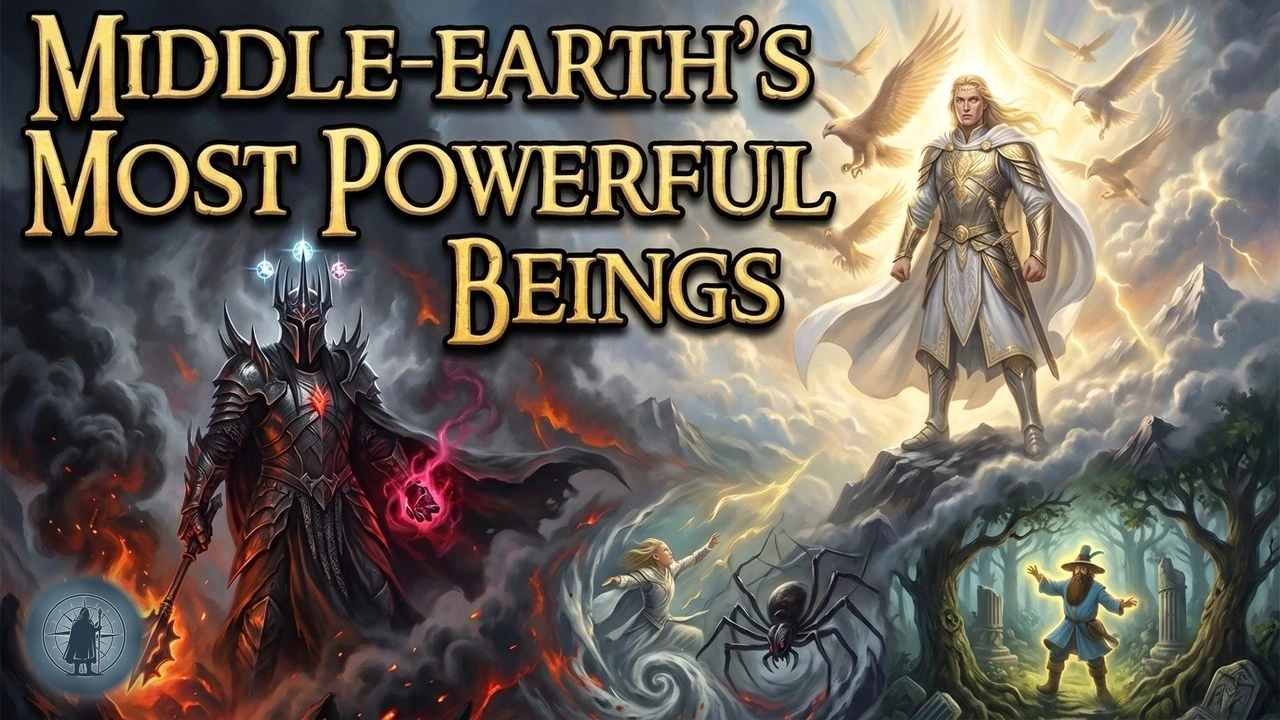
Middle-earth's Most Powerful Beings
 Watch the episode
Middle-earth's Most Powerful Beings | The Ranking Tolkien Refused
Watch the episode
Middle-earth's Most Powerful Beings | The Ranking Tolkien Refused
Research Notes: The 10 Most Powerful Beings in Middle-earth
Sufficiency check for the writer: this topic has abundant material — arguably too much.
Eight distinct analytical themes are supplied below, each with 3+ hard specifics, comfortably
supporting seven ~640-word sections. The risk on this episode is not thin research; it is
overlap with prior episodes (see the "Overlap warnings" block at the end of this file) and
the temptation to write ten mini-biographies instead of one argument. The themes below are
deliberately built around ranking mechanics, not character studies, for that reason.
How to read this file. It runs long (~20k words, well over the usual 5–8k) because
"Primary sources by tier" is a
quote bank, not required reading — dip into it for the tier you're writing. The parts to
read straight through are: Overview → Tolkien's own theory of power → *Discrete Analytical
Themes → Overlap warnings. The Fact-check traps* block should be read before drafting and
again before submitting; this topic is a superlative-generator and several of the "facts"
everyone repeats about it are wrong.
Overview
"Most powerful being in Middle-earth" is a question Tolkien never answers, and the reason he never answers it is the most interesting thing about the question.
There is no power system in the legendarium. There are no levels. What there is instead is a scatter of superlative phrases — "the mightiest of those Ainur who came into the World," "greatest in strength and deeds of prowess," "wisest of the Maiar," "whose might in arms is surpassed by none in Arda" — dropped into the Valaquenta and never reconciled with each other or with what actually happens in the stories. When you try to build a ladder out of them, the ladder immediately falls over, because the narrative keeps producing results the rankings can't explain: an Elf-king wounds a fallen Vala seven times; a Maia loses a fight to a dog; the being explicitly called "the mightiest" spends the end of his career limping, scarred, and afraid to leave his own fortress.
Tolkien's own explanation for this — set out in the late essay "Notes on Motives in the Silmarillion," published in Morgoth's Ring — is that **power in Arda is not a stat, it is a budget.** It is spent, and what is spent does not come back. Morgoth begins with the largest share of it of any created being and ends the First Age poorer, in real terms, than his own lieutenant. Sauron makes the same trade later, more cheaply and more cleverly, and ends the Third Age as a spirit of malice with no body at all. The wizards are sent to Middle-earth with their power deliberately capped. The greatest Valar simply never come.
So the honest version of this episode is not a tier list. It is a demonstration that the tier list keeps breaking, and an account of the four or five mechanics that break it: dissipation, authority versus might, geography, self-binding, and the hard metaphysical ceiling that means no power in Arda — none, including Eru's own, by his own choice — can force a mind that refuses.
The ten (a workable running order, with the argument each placement has to survive):
| # | Being | Category | The objection the episode must answer | |---|---|---|---| | 1 | Eru Ilúvatar | The One | "He isn't in Middle-earth" — and he intervenes directly maybe three times | | 2 | Melkor / Morgoth | Vala (fallen) | He is also the being who loses the most; by FA 587 he is halt, scarred, and beaten | | 3 | Manwë | Vala, Elder King | He is not the strongest and he is repeatedly outmanoeuvred; his power is office, not force | | 4 | Ungoliant | Uncategorised | Not a Vala, not listed among the Maiar, possibly not of the Music at all | | 5 | Sauron | Maia | Textually "greater, effectively" than late Morgoth — but he loses to a hound | | 6 | Tulkas | Vala | Beat Morgoth twice, bare-handed — and is worth nothing outside a fight | | 7 | Eönwë | Maia | His famous superlative may not be Tolkien's sentence at all (see Theme 1) | | 8 | Lúthien | Half-Maia, half-Elf | Broke both Dark Lords — but never in a contest of raw force | | 9 | Tom Bombadil | Unclassifiable | Master of a small country and nothing beyond it | | 10 | Gandalf / Olórin | Maia, bound | "Wisest of the Maiar" operating at a fraction of his own strength |
Deliberately not in the ten, with reasons the script should give out loud: Varda (feared more than any other, but no recorded contest), Ulmo (the only Vala who never left, but works only through others), Melian (a thousand-year enchantment, one province wide), Fëanor, Fingolfin, Glorfindel, Eärendil, Galadriel, Saruman, Gothmog, Durin's Bane, Shelob, Ancalagon.
Tolkien's own theory of power (the spine of the episode)
This is the material that separates this episode from a listicle. Tolkien wrote about power directly and often, and he is unusually specific.
1. Power is spent, not held — the dissipation law
From "Notes on Motives in the Silmarillion" (Morgoth's Ring, HoME X, "Myths Transformed", Text VII — the essay that gives the volume its title):
"To gain domination over Arda, Morgoth had let most of his being pass into the physical
constituents of the Earth — hence all things that were born on Earth, and lived on and by it,
beasts or plants or incarnate spirits, were liable to be stained."
"Melkor 'incarnated' himself (as Morgoth) permanently. He did this so as to control the
hroa, the 'flesh' or physical matter, of Arda. He attempted to identify himself with it.
A vaster, and more perilous, procedure, though of similar sort to the operations of Sauron
with the Rings."
"But in this way Morgoth lost (or exchanged, or transmuted) the greater part of his original
'angelic' powers, of mind and spirit, while gaining a terrible grip upon the physical world."
"Sauron's, relatively smaller, power was concentrated; Morgoth's vast power was disseminated.
The whole of 'Middle-earth' was Morgoth's Ring, though temporarily his attention was mainly
upon the North-west."
⚠️ A FAKE QUOTE TO KILL ON SIGHT. The sentence that circulates everywhere —
*"Just as Sauron concentrated his power in the One Ring, Morgoth dispersed his power into the
very matter of Arda, thus the whole of Middle-earth was Morgoth's Ring"* — is not Tolkien.
It is a Wikipedia/editorial summary, and it has already been repeated as a direct quotation
inside this channel's own earlier research (arda-marred-how-morgoth-broke-the-world/research/, lines 40 and 674). Tolkien's actual sentence is the short one above. Use that.
notes.md
And the sentence that reorders the entire ranking:
"Sauron was 'greater', effectively, in the Second Age than Morgoth at the end of the First.
Because, though he was far smaller by natural stature, he had not yet fallen so low."
The same mechanic is stated inside the published Silmarillion too — in the Arien passage of Ch. 11, "Of the Sun and Moon and the Hiding of Valinor," which is the version a general audience can actually be handed:
"…as he grew in malice, and sent forth from himself the evil that he conceived in lies and
creatures of wickedness, his might passed into them and was dispersed, and he himself became
ever more bound to the earth, unwilling to issue from his dark strongholds."
Why this matters for a ranking: the One Ring is not an anomaly. It is Sauron doing deliberately, cheaply and reversibly what Morgoth did compulsively, expensively and permanently. Sauron put a portion of himself into an object he could pick up. Morgoth put most of himself into a planet he could never pick up again. That is why the Ring could be unmade in a single afternoon at Orodruin and the Marring of Arda cannot be undone at all.
2. Power that coerces is a different thing from power that makes
Letter 131 (to Milton Waldman, ~1951) — Tolkien's own taxonomy, and the reason "who would win" is the wrong question in his world:
"But to achieve this he had been obliged to let a great part of his own inherent power (a
frequent and very significant motive in myth and fairy-story) pass into the One Ring."
(Note the exact word: "inherent," not "former." This is misquoted constantly.)
Also from 131, on the two kinds of power: the Elves' "magic" is Art, and "its object is Art not Power, sub-creation not domination and tyrannous re-forming of Creation." Against that, "the Machine" — "our more obvious modern form though more closely related to Magic than is usually recognised" — is the use of "external plans or devices" instead of inherent gifts, or the use of inherent gifts "for the corrupted motive of dominating: bulldozing the real world, or coercing other wills."
Letter 155 refines it: Tolkien distinguishes magia (the physical, effective kind) from goeteia (illusion, the "enchanter's" kind), and insists that in his story "neither is good or bad except by motive or purpose or use."
3. Power has a hard ceiling — the will cannot be forced
This is the least-known and most useful piece of the argument. In Ósanwe-kenta ("Enquiry into the Communication of Thought"), a short essay of c. 1959–60 appended to Quendi and Eldar and published in Vinyar Tengwar 39 (1998, ed. Carl F. Hostetter), Tolkien sets out the rules of mind-to-mind contact:
- All minds are naturally open; that is their state in Arda Unmarred. - Every being has the right to close its mind, raising a barrier of unwill — Quenya avanir. - That barrier cannot be forced. It belongs to the class of únati, things that cannot be done at all. And the reason is a feedback rule: **the greater the force applied, the greater the resistance it generates.** - Melkor, applying the whole of his power and will, could not break it either.
CITATION CAUTION: Vinyar Tengwar 39 is not freely available and I could not retrieve the
essay's own wording. The four points above are reliable summary (Tolkien Gateway's
Ósanwe-kenta and ósanwë entries), not quotation. Do not put invented quotation marks
around any of it in the script.
The consequence for the ranking is large: the single most valuable thing a Dark Lord could possibly want — direct control of another mind — is the one thing the universe is built to refuse. Which is exactly why Sauron has to build a ring. He cannot take wills; he can only buy them.
4. The Ainur are creatures, not gods, and are bounded by the world
Letter 181: the mythology is "monotheistic but 'sub-creational'," in which the Valar "take the imaginative but not theological place of 'gods'." Letter 153: an Elf may call on a Vala "as a Catholic might on a Saint, though no doubt knowing in theory as well as he that the power of the Vala was limited and derivative." Letter 200: the Ainur "did not need to be physically incarnated. They could self-incarnate, but these forms were more analogous to clothing than bodies… the forms were an expression of desires, moods, wills, and functions." The technical term is fana — and losing the ability to make one is the clearest measurable demotion in the legendarium (Sauron after Númenor; Morgoth after his permanent incarnation).
5. Even righteous power corrupts — Letter 246
"But if Gandalf had been the victor it would have been far worse than Sauron winning. The
'righteous' Gandalf would have become self-righteous, ruling and ordering things for 'good'
until he had made good detestable and seem evil."
This is the answer to "why doesn't Gandalf just use the Ring and top the list."
Primary sources by tier
Tier 0 — Eru Ilúvatar
The Ainulindalë (The Silmarillion):
"No theme may be played that hath not its uttermost source in me, nor can any alter the music
in my despite. For he that attempteth this shall prove but mine instrument in the devising of
things more wonderful, which he himself hath not imagined."
"Therefore I say: Eä! Let these things Be! And I will send forth the flame imperishable into
the Void, and it shall be at the heart of the World, and the World shall Be; and those of you
that will may go down into it."
And Eru's rebuke to Melkor, which does double duty — the absolute authorship claim and Eru himself, on the record, naming Melkor the mightiest of the Ainur:
"Then Ilúvatar spoke, and he said: 'Mighty are the Ainur, and **mightiest among them is
Melkor**; but that he may know, and all the Ainur, that I am Ilúvatar, those things that ye
have sung, I will show them forth, that ye may see what ye have done…'"
The power cap. The most under-used line in the Ainulindalë, and the reason no Vala can ever be ranked alongside Eru:
"But this condition Ilúvatar made, or it is the necessity of their love, that **their power
should thenceforward be contained and bounded in the World**, to be within it for ever, until
it is complete, so that they are its life and it is theirs. And therefore they are named the
Valar, the Powers of the World."
Entering Eä is a limitation. Every Vala accepted a permanent cap Eru does not share. It is also the strongest argument for the editorial position that **Eru is the frame of this list, not an entry on it.**
The Flame Imperishable (the Secret Fire) is the mechanic of true creation, and it is Eru's alone:
"To Melkor among the Ainur had been given the greatest gifts of power and knowledge, and he
had a share in all the gifts of his brethren. He had gone often alone into the void places
seeking the Imperishable Flame; for desire grew hot within him to bring into Being things of
his own, and it seemed to him that Ilúvatar took no thought for the Void, and he was impatient
of its emptiness. Yet he found not the Fire, for it is with Ilúvatar."
Nine words — "yet he found not the Fire, for it is with Ilúvatar" — are the ceiling on every other being in the episode. Nobody below Eru can make anything that lives on its own.
Aulë and the Dwarves is the proof case, and it is the cleanest illustration of the gap between rank one and rank two anywhere in Tolkien. Ilúvatar to Aulë: "For thou hast from me as a gift thy own being only, and no more; and therefore the creatures of thy hand and mind **can live only by that being, moving when thou thinkest to move them, and if thy thought be elsewhere, standing idle.**" The greatest craftsman among the Valar could build bodies but could not put a will inside one. His Dwarves were puppets until Eru said: "Even as I gave being to the thoughts of the Ainur at the beginning of the World, so now I have taken up thy desire and given to it a place therein." (The Silmarillion, Ch. 2, "Of Aulë and Yavanna.")
Tolkien told Clyde S. Kilby that the Secret Fire represents the Holy Spirit; Christopher glossed it as "the mystery of authorship." (Both secondary attributions, not Letters — cite as reported.)
Direct interventions — remarkably few, which is the point: - The Ainulindalë itself, and the "Eä" that makes the Music real. - The adoption of the Dwarves (Years of the Lamps). - The Awakening of the Elves at Cuiviénen; the coming of Men. - Lúthien's petition: Mandos "was moved to pity, who never before was so moved, nor has been since," and the case is referred upward to Manwë, who "sought counsel in his inmost thought, where the will of Ilúvatar was revealed." - The Downfall of Númenor, SA 3319. "Then Manwë upon the Mountain called upon Ilúvatar, and for that time the Valar laid down their government of Arda. … But Ilúvatar showed forth his power, and he changed the fashion of the world; and a great chasm opened in the sea between Númenor and the Deathless Lands" (Akallabêth). Letter 211 is explicit that this is a direct act of God: Sauron "was first defeated by a 'miracle': a direct action of God the Creator, changing the fashion of the world, when appealed to by Manwë. Though reduced to 'a spirit of hatred borne on a dark wind', I do not think one need boggle at this spirit carrying off the One Ring, upon which his power of dominating minds now largely depended." **Note the mechanism: Manwë petitions; Eru acts. That is the whole Manwë case in one sentence.** - Gandalf's return, TA Feb 3019 — Letter 156: "He was sent by a mere prudent plan of the angelic Valar or governors; but Authority had taken up this plan and enlarged it, at the moment of its failure. 'Naked I was sent back — for a brief time, until my task is done.'" And, asked *by whom Gandalf was sent back, Tolkien is precise: *"Not by the 'gods' whose business is only with this embodied world and its time; for he passed 'out of thought and time'."** The capitalised "Authority," explicitly distinguished from the Valar, is Eru. **Resurrection is outside Valarin competence.**
The honest objection: Eru is not a being in Middle-earth in any ordinary sense. He acts about five times in ~37,000 years of recorded history, and never in person. A ranking that puts him at #1 and stops has said nothing.
Tier 1 — the Valar
How many, and who outranks whom. Valaquenta: "The Lords of the Valar are seven; and the Valier, the Queens of the Valar, are seven also." Lords: Manwë, Ulmo, Aulë, Oromë, Mandos, Lórien, Tulkas. Queens: Varda, Yavanna, Nienna, Estë, Vairë, Vána, Nessa. And: "Melkor is counted no longer among the Valar, and his name is not spoken upon Earth." So fourteen in the roll, fifteen if Melkor is restored to the count. (The channel's own visual-canon note already fixes 14 for council scenes.)
The Aratar — the only formal ranking Tolkien ever wrote: "the High Ones of Arda," eight of them — Manwë and Varda, Ulmo, Yavanna and Aulë, Mandos, Nienna, and Oromë — held in equal reverence, with "a majesty that surpasses even the other Valar."
The single best ranking argument in the whole episode is hiding in that list. Tulkas —
"greatest in strength and deeds of prowess," the being who personally beat Melkor twice — is
not one of the Aratar. Tolkien's own top eight excludes his strongest fighter. Which
proves the point: Tolkien's hierarchy was never a power ranking. It ranks majesty, office
and closeness to Eru's purpose. Fans have spent fifty years reading it as a stat block.
(Caveat: the widely repeated claim that the Aratar were originally nine *including Melkor is
standard fandom and probably right, but the exact Valaquenta wording could not be verified.
Soften or drop.)*
#### MANWË — authority without supremacy
Three passages, and none of them says what fans assume:
"Manwë and Melkor were brethren in the thought of Ilúvatar. **The mightiest of those Ainur
who came into the World was in his beginning Melkor**; but Manwë is dearest to Ilúvatar and
understands most clearly his purposes. He was appointed to be, in the fullness of time, the
first of all Kings: lord of the realm of Arda and ruler of all that dwell therein."
— Valaquenta
"But Manwë was the brother of Melkor in the mind of Ilúvatar, and he was the chief instrument
of the second theme that Ilúvatar had raised up against the discord of Melkor." — Ainulindalë
"But of the airs and winds Manwë most had pondered, who is the noblest of the Ainur."
— Ainulindalë
**The pattern is unmistakable and the script should say it out loud: Tolkien never once calls Manwë the mightiest.** Noblest. Dearest to Ilúvatar. Understands most clearly. First of all Kings. Every Manwë superlative is about office, intimacy with Eru, and moral standing. The power superlatives all go to Melkor — from Eru's own mouth.
AVOID: "vice-gerent of Eru" is repeated everywhere online but could not be traced to
chapter and verse. Use the verified Valaquenta wording — "first of all Kings: lord of the
realm of Arda" — instead.
Manwë's defining failure (The Silmarillion, **Ch. 6, "Of Fëanor and the Unchaining of Melkor"** — note: Ch. 6, not Ch. 8):
"For Manwë was free from evil and could not comprehend it, and he knew that in the beginning,
in the thought of Ilúvatar, Melkor had been even as he; and he saw not to the depths of
Melkor's heart, and did not perceive that all love had departed from him for ever."
Melkor is released from Mandos in YT 1400, after three ages of bondage; Nienna pleads for him, Mandos is silent, Manwë pardons him. The bill comes due in YT 1495: the Two Trees destroyed, the Silmarils stolen, Finwë murdered, the Kinslaying at Alqualondë, the exile of the Noldor, and five centuries of war. **The King of Arda's incorruptibility is also his single greatest vulnerability. He cannot model an enemy he cannot imagine being.**
The Ósanwe-kenta supplies the mechanism, and it is the most elegant thing in this research: Manwë's mind was permanently open, because his whole purpose was to enact Eru's will and he had nothing to hide. Melkor's was permanently closed. So Melkor could always read Manwë's intent, and Manwë could never read Melkor's. *The most transparent being in Arda was, structurally, the easiest to deceive.* (Summary, not quotation — see the citation caution above.)
Authority in practice — what Manwë's power actually looks like: - Eärendil at the Ring of Doom: "In this matter the power of doom is given to me" — Manwë personally suspends Mandos' standing decree that no mortal may set foot in Aman and live, on the grounds that Eärendil came not for himself but for the Two Kindreds. - He then authorises the Host of the West — but the Host is led by Eönwë, not by Manwë. - Varda multiplies him: "When Manwë… ascends his throne and looks forth, if Varda is beside him, he sees further than all other eyes, through mist, and through darkness, and over the leagues of the sea." - Númenor, SA 3319 — the decisive datum. "Then Manwë upon the Mountain called upon Ilúvatar, and for that time the Valar laid down their government of Arda." Faced with Ar-Pharazôn's armada, the entire pantheon resigns, and Eru reshapes the planet. Manwë's greatest single act of power is asking someone else.
#### MELKOR / MORGOTH — the strongest being, and the biggest loser
Starting position, from Eru himself:
"Then Ilúvatar spoke, and he said: 'Mighty are the Ainur, and **mightiest among them is
Melkor**; but that he may know, and all the Ainur, that I am Ilúvatar…'" — Ainulindalë
"To Melkor among the Ainur had been given the greatest gifts of power and knowledge, and he
had a share in all the gifts of his brethren." — Ainulindalë *(not the Valaquenta — this
is misattributed constantly, including in prior channel research)*
Valaquenta, "Of the Enemies": "Great might was given to him by Ilúvatar, and he was coeval with Manwë. In the powers and knowledge of all the other Valar he had part, but he turned them to evil purposes, and squandered his strength in violence and tyranny." And: "From splendour he fell through arrogance to contempt for all things save himself, a spirit wasteful and pitiless."
Tolkien's own late note-to-self on revising the mythology upward (Morgoth's Ring, p. 339, 1955 essay): **"Melkor must be made far more powerful in original nature. The greatest power under Eru. Later, he must not be able to be controlled or 'chained' by all the Valar combined."** (Note the collision: this would retroactively delete Tulkas's greatest feat.)
The wounds — a god turning into a body: - Ungoliant, YT 1495. She had grown great, "and he less by the power that had gone out of him." She enmeshes him in webs and would have strangled him. "The cry of Morgoth in that hour was the greatest and most dreadful that was ever heard in the northern world; **the mightiest of the Valar cried aloud for aid**, and the mountains shook, and the earth trembled, and the rocks were riven asunder." The Balrogs come from Angband and drive her off with whips of flame. The mightiest being in Arda is rescued by his own staff from a spider. - Fingolfin, FA 456. "He wounded Morgoth with seven wounds, and seven times Morgoth gave a cry of anguish, whereat the hosts of Angband fell upon their faces in dismay, and the cries echoed in the Northlands." *(A variant wording circulates — "he wounded Morgoth seven times with his sword; and the cries of Morgoth echoed in the north-lands." The channel's own verified Fingolfin research uses the first; keep to it.) And: "*Morgoth went ever halt of one foot after that day**, and the pain of his wounds could not be healed; and in his face was the scar that Thorondor made." - The first and worst wound is the one nobody remembers, and it is in the published book — Ch. 9, before Fingolfin by centuries: "**His hands were burned black by the touch of those hallowed jewels, and black they remained ever after; nor was he ever free from the pain of the burning, and the anger of the pain.**" The Dark Lord spends the entire First Age in constant pain from the objects he stole, holding them in a crown he cannot take off. - Permanent injury is the whole proof. An unhoused Ainu can simply discard a damaged form and make another. Morgoth cannot. The limp is the receipt for the dissipation. - The full catalogue of permanent injuries, in order — worth putting on screen as a list, because it demolishes the "Fingolfin gave him the only wounds he ever took" superlative four times over: (1) the Silmarils burn his hands black, forever, Ch. 9; (2) Ungoliant, same chapter; (3) Fingolfin — seven wounds and the hewn foot, Ch. 18; (4) Thorondor — the face, same page. The sentence that records the limp records the eagle's scar in the same breath. - After the duel he never leaves Angband again, fighting only through Glaurung, the Balrogs and Orc-armies. - Also: Fingolfin "named Morgoth craven, and lord of slaves," and Morgoth "could not now deny the challenge before the face of his captains." He fought because his own officers were watching.
⚠️ THE COUNTEREVIDENCE THE EPISODE MUST HANDLE. The dissipation thesis is a *late, post-1955 authorial revision, and it sits badly against the published Silmarillion*, which reasserts Morgoth's supremacy in the very period he is supposedly emptying out. From Ch. 18, at roughly FA 455:
"…though his might was greatest of all things in this world, **alone of the Valar he knew
fear**."
One sentence, both sides of the argument. "Greatest of all things in this world" at FA 455, long after the dissipation was well advanced — and "alone of the Valar he knew fear," the behavioural evidence for the thesis. **"Greater in power" and "greater in effective threat" come apart, and Tolkien never reconciled the two versions.** Christopher Tolkien warned readers that they enter "Myths Transformed" at their peril, since there they watch the author "probing the absolute rock-bottom theoretical base of his subcreation." A ranking built entirely on the dissipation thesis is a ranking built on the author's scratch paper — and the script should concede that rather than have a commenter concede it for us.
The end. War of Wrath, ≈ FA 545–587. Morgoth will not fight; he flees to his deepest pits and at the last sues for pardon. His feet are cut from under him, he is bound again with Angainor, and the iron crown is beaten into a collar. Then:
"But Morgoth himself the Valar thrust through the Door of Night beyond the Walls of the World,
into the Timeless Void; and a guard is set for ever on those walls, and Eärendil keeps watch
upon the ramparts of the sky." — Ch. 24
(The Dagor Dagorath — Morgoth's prophesied return — is not in the published Silmarillion*; Christopher removed it. It survives in HoME and is alluded to in Letter 131. Flag if used. "His feet were hewn from under him" — exact wording unverified; sources give "cut from under him".)*
#### TULKAS — the pure-strength case, and its ceiling
"It is told among the wise that the First War began before Arda was full-shaped… and for long
Melkor had the upper hand. But in the midst of the war a spirit of great strength and hardihood
came to the aid of the Valar, hearing in the far heaven that there was battle in the Little
Kingdom; and Arda was filled with the sound of his laughter. So came Tulkas the Strong,
whose anger passes like a mighty wind, scattering cloud and darkness before it; and **Melkor
fled before his wrath and his laughter, and forsook Arda**, and there was peace for a long age."
— Ch. 1, "Of the Beginning of Days"
Melkor was winning until Tulkas arrived, and then left the planet. That is the single biggest one-being feat below Eru anywhere in the legendarium.
Valaquenta: "Greatest in strength and deeds of prowess is Tulkas, who is surnamed Astaldo, the Valiant… he rides no steed, for he can outrun all things that go on feet, and he is tireless. His hair and beard are golden, and his flesh ruddy; his weapons are his hands."
Battle of the Powers / Chaining of Melkor (≈ YT 1090–1100): "Then Tulkas stood forth as champion of the Valar and wrestled with him, and cast him upon his face; and he was bound with the chain Angainor that Aulë had wrought, and led captive."
And the ceiling, in Tolkien's own words:
"He has little heed for either the past or the future, and is of no avail as a counsellor,
but is a hardy friend."
*(Exact wording: "of no avail", not "of little avail" — verified against two independent transcriptions. This matters; "no avail" is the stronger and correct line.)*
The strongest being in Arda is useless in the room where the decision gets made — and is left off Tolkien's own list of the eight High Ones. That is the ranking's cleanest joke on itself.
⚠️ Did Tulkas fight in the War of Wrath? Unknown. Tolkien never says whether any Vala personally fought; the Host was led by Eönwë and made up of the Vanyar and the Noldor of Aman. "Notes on Motives" implies the Valar took direct action, without specifics. **Every fan claim that "Tulkas bound Morgoth again" is inference, not text. Assert nothing.**
#### VARDA — the strongest "should she be higher?" case
"…for Melkor she knew from before the making of the Music and rejected him, and he hated her,
and feared her more than all others whom Eru made." — Valaquenta
Morgoth's most-feared being is not Manwë and not Tulkas. It is Varda — and she is never once shown fighting. That is the reason "A Elbereth Gilthoniel" still works as a weapon against Nazgûl three ages and half a world away.
#### ULMO — the Vala who never left
"He is next in might to Manwë, and before Valinor was made he was closest to him in
friendship; but thereafter he went seldom to the councils of the Valar, unless great matters
were in debate."
"Ulmo loves both Elves and Men, and **never abandoned them, not even when they lay under the
wrath of the Valar**."
"Next in might to Manwë" is an explicit in-text power ranking — rare and quotable. Combine it with the fact that Ulmo alone kept working inside Middle-earth through the whole Dark (Turgon and the founding of Gondolin; Tuor; the warning to Nargothrond; he opposed the Hiding of Valinor outright) and Ulmo has a serious claim on effective power over both Manwë and Aulë. He is the key exhibit for the geography-of-power theme.
#### AULË, MANDOS, OROMË, NIENNA — short
- Aulë: "to whom Ilúvatar had given skill and knowledge scarce less than to Melkor; but the delight and pride of Aulë is in the deed of making, and in the thing made, and neither in possession nor in his own mastery; wherefore he gives and hoards not." (Ainulindalë.) *Same gift as Melkor, opposite disposition* — the cleanest statement in Tolkien that power is defined by what you want to do with it. He also forged Angainor, the chain that held Morgoth. - Mandos / Námo: the constraint nobody escapes. He pronounces the Doom of the Noldor and the decree that no mortal may set foot in Aman and live; even Manwë's ruling on Eärendil is framed as needing special authority to override him. - Oromë: the only Vala who kept riding into Middle-earth during the long dark; he found the Elves at Cuiviénen, which triggered the Battle of the Powers. - Nienna: teaches pity and endurance; Olórin was her pupil — and she is the one who pleaded for Melkor's release, making the wisest teacher in Valinor a contributing cause of the catastrophe.
#### Tolkien grading his own gods
From "Notes on Motives" (Morgoth's Ring):
"The 'Hiding of Valinor' came near to countering Morgoth's possessiveness by a rival
possessiveness, setting up a private domain of light and bliss against one of darkness and
domination."
"The wiser they became the less power they had to do anything — save by counsel."
(That second line is Morgoth's Ring, not a Letter. Do not cite it as a Letter.)
And the strategic bind that explains the whole Valar arc:
"Arda could only be liberated by a physical battle; but a probable result of such a battle was
the irretrievable ruin of Arda. Moreover, the final eradication of Sauron (as a power directing
evil) was achievable by the destruction of the Ring. No such eradication of Morgoth was
possible, since this required the complete disintegration of the matter of Arda."
The Valar's arc across the Ages is descending intervention: they fight the First War; they fight the Battle of the Powers; they hide; they send an army once, for Eärendil; they resign outright at Númenor; and by the Third Age they send **five old men with their power deliberately veiled**. That is not a pantheon losing strength. It is a pantheon that has concluded strength is the wrong tool.
Tier 2 — the Maiar
Sauron. Valaquenta, "Of the Enemies":
"Among those of his servants that have names the greatest was that spirit whom the Eldar
called Sauron, or Gorthaur the Cruel. In his beginning he was of the Maiar of Aulë, and he
remained mighty in the lore of that people."
"In all the deeds of Melkor the Morgoth upon Arda, in his vast works and in the deceits of his
cunning, Sauron had a part, and was only less evil than his master in that for long he served
another and not himself."
Read the construction carefully. Sauron is "the greatest" of Melkor's named servants — which is a set that includes Gothmog, Lord of Balrogs. And the only moral gap the text records between Sauron and Morgoth is subordination, not degree of evil.
His original name was Mairon, "the Admirable" (Parma Eldalamberon 17) — from the same root maira that gives Maiar. He kept styling himself Tar-mairon, "King Excellent," until Númenor. "Sauron" is a name given by others: "the Abhorred."
Letter 183: "Sauron was of course not 'evil' in origin. He was a 'spirit' corrupted by the Prime Dark Lord (the Prime sub-creative Rebel) Morgoth." And, crucially for tiering: he was "of the same kind as Gandalf and Saruman, but of a far higher order."
The Akallabêth on the loss of his fair form (SA 3319):
"But Sauron was not of mortal flesh, and though he was robbed now of that shape in which he
had wrought so great an evil, so that he could never again appear fair to the eyes of Men,
yet his spirit arose out of the deep and passed as a shadow and a black wind over the sea,
and came back to Middle-earth and to Mordor that was his home."
Gandalf's forecast of the end state (Council of Elrond): "he will lose the best part of the strength that was native to him in his beginning… he will be maimed for ever, becoming a mere spirit of malice that gnaws itself in the shadows, but cannot again grow or take shape."
The anti-Sauron datapoint: at Tol-in-Gaurhoth (FA 465) the greatest of Morgoth's named servants was physically beaten by a hound of Valinor and a single Elf-maiden. "Then Sauron yielded himself," and fled in the form of a vampire, "great as a dark cloud across the moon… dripping blood from his throat upon the trees."
Eönwë — and the single most important finding in this research.
The line every fan tier-list is built on, from the published Valaquenta:
"Chief among the Maiar of Valinor whose names are remembered in the histories of the Elder
Days are Ilmarë, the handmaid of Varda, and Eönwë, the banner-bearer and herald of Manwë,
whose might in arms is surpassed by none in Arda."
*Christopher Tolkien states in Morgoth's Ring* that the clause "whose might in arms is surpassed by none in Arda" was his own editorial addition**, made to prepare the reader for Eönwë's command of the Host of the West at the Great Battle. If that is right — and it is reported consistently in the Morgoth's Ring commentary on the Valaquenta material — then the most-quoted power statement in the entire legendarium was **written by the editor, to justify a plot role.**
VERIFY BEFORE BROADCAST. This is a headline-grade claim and it should be checked against
the printed volume (Morgoth's Ring, commentary to the later Valaquenta / "Of the Maiar")
before the script asserts it flatly. If it cannot be verified to a page, soften to: "*the
phrase does not appear in Tolkien's own drafts of the Valaquenta, and Christopher's commentary
indicates it was supplied editorially*". Note also that the sentence is in the published
Silmarillion, so it is canon-as-published; the claim is about authorship, not about canonicity.
The channel's own canon corpus (production/guides/canon/beings/eonwe/canonical.md) currently
cites it as a straight Valaquenta quote — that entry may need a footnote.
The counterweight the same book supplies — Eönwë refusing to judge Sauron after the War of Wrath:
"But it was not within the power of Eönwë to pardon those of his own order, and he commanded
Sauron to return to Aman and there receive the judgement of Manwë."
"Those of his own order." The text rates Eönwë and Sauron as peers in rank. Sauron's submission to him was diplomatic, not forced — and Sauron then simply left rather than comply.
Gandalf / Olórin. Valaquenta:
"Wisest of the Maiar was Olórin. He too dwelt in Lórien, but his ways took him often to the
house of Nienna, and of her he learned pity and patience."
"…for though he loved the Elves, he walked among them unseen, or in form as one of them, and
they did not know whence came the fair visions or the promptings of wisdom that he put into
their hearts."
"Wisest of the Maiar" is an unqualified superlative over a set that includes Sauron.
The binding, from Unfinished Tales, "The Istari":
"For with the consent of Eru they sent members of their own high order, but clad in bodies as
of Men, real and not feigned, but subject to the fears and pains and weariness of the earth,
able to hunger and thirst and be slain; though because of their noble spirits they did not
die, and aged only by the cares and labours of many long years."
"…their emissaries were forbidden to reveal themselves in forms of majesty, or to seek to rule
the wills of Men or Elves by open display of power, but coming in shapes weak and humble were
bidden to advise and persuade Men and Elves to good."
"For they must be mighty, peers of Sauron, but must forgo might, and clothe themselves in
flesh so as to treat on equality and win the trust of Elves and Men."
The short form — "forbidden to match his power with power" — is genuine Unfinished Tales, "The Istari." It is not a Letter. (One of the channel's own earlier research files mis-attributes it to Letter 156; do not repeat that.)
A live contradiction worth putting on screen: Unfinished Tales calls the Istari "peers of Sauron." Letter 183 calls Sauron "of a far higher order" than Gandalf and Saruman. Both are Tolkien. The usual reconciliation — that they were peers as unhoused spirits and became lesser once incarnated and self-limited — is coherent but is stated nowhere. Flag it as interpretation, not fact.
Gandalf's own claims: "I am a servant of the Secret Fire, wielder of the flame of Anor. You cannot pass. The dark fire will not avail you, flame of Udûn" (FotR, "The Bridge of Khazad-dûm"); "Indeed my friends, none of you have any weapon that could hurt me" and "Indeed I am Saruman, one might almost say, Saruman as he should have been" (TT, "The White Rider").
Letters 156 and 181 on the return — attribution between the two letters is muddled in secondary sources, so cite them jointly: - "Gandalf really 'died', and was changed: for that seems to me the only real cheating, to represent anything that can be called 'death' as making no difference." - "The 'wizards', as such, failed; or if you like: the crisis had become too grave and needed an enhancement of power. So Gandalf sacrificed himself, was accepted, and enhanced, and returned." - "Of course he remains similar in personality and idiosyncrasy, but both his wisdom and power are much greater."
Saruman. "The chief of my order and the head of the Council" (Gandalf, Council of Elrond). Unfinished Tales: "his knowledge was deep, his thought was subtle, and his hands marvellously skilled; and he had a power over the minds of others. The wise he could persuade, and the smaller folk he could daunt." Varda's line at the choosing of the Istari — "Not as the third" — "and Curumo remembered it." And, from the same chapter: "**Indeed of all the Istari, one only remained faithful.**"
Melian. The Silmarillion, "Of the Sindar":
"…the Girdle of Melian, that none thereafter could pass against her will or the will of King
Thingol, unless one should come with a power greater than that of Melian the Maia."
Do not let the script say "nothing could pass the Girdle." It was breached twice, and the text explains both: Beren, because "his doom was greater," and Carcharoth, carrying the Silmaril. Fate outranked her power in both cases. What is true is narrower and better: no servant of Morgoth, acting as a servant of Morgoth, ever got through. The Girdle stood from the return of the Noldor to Thingol's death — dated FA 502 or 503 depending on which chronology is used (published Silmarillion vs. the later Annals differ; flag rather than pick).
Melian is also the only Ainu to marry an incarnate and bear a child — which makes her the origin point of the entire Half-elven line: Lúthien, Dior, Elwing, Elrond and Elros, and through Elros the Kings of Númenor and Aragorn.
Balrogs / Gothmog / Durin's Bane. Valaquenta: "Dreadful among these spirits were the Valaraukar, the scourges of fire that in Middle-earth were called the Balrogs, demons of terror." Sindarin Balrog = "Demon of Might" (bal "power" + raug/rog "demon"); Quenya Valarauko.
The number is a genuine textual variant and should be presented as one: - The Book of Lost Tales II (c. 1917): Balrogs in the hundreds, riding dragons at Gondolin; Gothmog is a son of Melko, not a Maia at all. - Quenta Silmarillion (c. 1937): "there came Balrogs one thousand." - Annals of Aman (c. 1958): still "a host of Balrogs" in the narrative text. - A marginal note in the same late material (Morgoth's Ring, Annals of Aman §2, note 50): "There should not be supposed more than say 3 or at most 7 ever existed." - The published Silmarillion takes no position at all.
So the near-universal internet "fact" that there were at most seven Balrogs rests on **one marginal note**, contradicted by every narrative text Tolkien ever finished. That is a good, honest beat for a ranking episode.
Gothmog's kills — check these dates, they are commonly wrong: - Fëanor, Dagor-nuin-Giliath — YT 1497 (Years of the Trees), before the first rising of the Sun. Not "FA 1." "Smitten to the ground by Gothmog, Lord of Balrogs"; rescued by his sons, died of the wounds. - Fingon, Nirnaeth Arnoediad, FA 472 — and note that it took two Balrogs: "he fought with Gothmog, until another Balrog came behind and cast a thong of fire about him. Then Gothmog hewed him with his black axe." - Ecthelion, Fall of Gondolin, FA 510 — and Ecthelion killed him, both drowning in the King's Fountain.
Durin's Bane: woken TA 1980 by delving for mithril, killing Durin VI the same year; kills Náin I in TA 1981, after which the Dwarves abandon Khazad-dûm. Roughly **5,000 years** in hiding before the Fellowship arrives. The fight with Gandalf: Bridge of Khazad-dûm 15 January TA 3019; ten days of running battle from the deeps to the Endless Stair to the summit of Zirakzigil; Gandalf casts him down 25 January; returns 14 February.
Arien — a misquote to kill. The Silmarillion, Ch. 11: "Arien the maiden was mightier than he" — "he" is Tilion, steersman of the Moon, not Melkor. Fan sources routinely mangle this into "Arien was mightier than Melkor." The actual Melkor sentence is the dissipation passage quoted above: he feared her "having indeed no longer the power" — a statement about his decline, not her supremacy.
Tier 3 — the outliers and the Children
#### UNGOLIANT — power as subtraction
The Silmarillion, "Of the Darkening of Valinor," is unusually careful to tell you it doesn't know what she is:
"The Eldar knew not whence she came; but some have said that in ages long before she descended
from the darkness that lies about Arda, when Melkor first looked down in envy upon the Kingdom
of Manwë, and that in the beginning she was one of those that he corrupted to his service.
But she had disowned her Master, desiring to be mistress of her own lust, taking all things
to herself to feed her emptiness."
Note the hedges — "some have said," "it is said" — and note the decisive structural fact: Ungoliant is not listed among the Maiar in the Valaquenta. Every other significant Maia is. That omission is the strongest single argument that she is not of the Ainur at all, and it is the reason she belongs in a "breaks the hierarchy" section rather than in the Maia tier.
Her power is the exact inverse of everyone else's. The Ainur's power is sub-creation — adorning, making, ordering. Hers is unmaking:
"She sucked up all light that she could find, and spun it forth again in dark nets of
strangling gloom, until no light more could come to her abode; and she was famished."
The Unlight is the key concept, and there are two passages, both verified:
"A cloak of darkness she wove about them when Melkor and Ungoliant set forth: an Unlight, in
which things seemed to be no more, and which eyes could not pierce, for it was void."
"The Darkness that followed was more than loss of light. In that hour was made a Darkness that
seemed not lack but a thing with being of its own: for it was indeed made by malice out of
Light, and it had power to pierce the eye, and to enter heart and mind, and strangle the very will."
This is philosophically odd and worth the script's attention. Tolkien's whole metaphysics says evil is privation — a nothing, a lack. Letter 183: "I do not deal in Absolute Evil… since that is Zero." Ungoliant is a privation that has somehow acquired substance. Jonathan McIntosh (at The Flame Imperishable) frames it exactly: the Ainulindalë is Augustinian — darkness known through light — while Ungoliant's darkness is Manichaean, a positive rival principle. He first argued (2011) that Tolkien progressively "theologized" her into a fallen angel, then **publicly retracted it** (2012), arguing the ambiguity was constant and only the in-world characters' beliefs changed. *A scholar changing his mind in public about what Ungoliant is, is itself the best evidence that she can't be classified.*
And the growth: after the Trees, "Ungoliant belched forth black vapours as she drank, and swelled to a shape so vast and hideous that Melkor was afraid." The narrator states it flat. The being who "alone of the Valar knew fear" is recorded as afraid of exactly one entity — and it isn't a Vala.
The Lammoth scene is the single most important power datum in the legendarium, and this episode needs it more than any other:
- After the theft of the Silmarils she demands them; Morgoth refuses. - "Ungoliant had grown great, and he less by the power that had gone out of him." *(This is the first explicit statement of the dissipation, and it's in the published book, not in HoME.)* - She enmeshes him in webs; he screams. "The cry of Morgoth in that hour was the greatest and most dreadful that was ever heard in the northern world; **the mightiest of the Valar cried aloud for aid**, and the mountains shook, and the earth trembled, and the rocks were riven asunder." - The Balrogs come out of Angband and drive her off with whips of flame.
**So the being ranked #2 on any honest list was saved from death by his own staff, in a fight he started, against something that isn't even in the taxonomy.**
Her end is a rumour, not a record: "of the fate of Ungoliant no tale tells. Yet some have said that she ended long ago, when in her uttermost famine she devoured herself at last." Self-consumption is the logical endpoint of a being whose only mode is intake — the appetite finally has nothing left to eat but itself.
Descendant: Shelob, "the last child of Ungoliant to trouble the unhappy world" (TT, "Shelob's Lair") — and note the diminution across three Ages: Ungoliant drank the light of the Two Trees; Shelob is driven off by a hobbit with a glass phial. But the family trait survives intact, and Tolkien puts it in a parenthesis that is worth the whole section:
"She was there before Sauron, and before the first stone of Barad-dûr; and she served none but
herself… And sometimes as a man may cast a dainty to his cat (**his cat he calls her, but she
owns him not**) Sauron would send her prisoners that he had no better uses for."
"His cat he calls her, but she owns him not." Morgoth couldn't own the mother; Sauron can't own the daughter. The defining property of this line is that it cannot be recruited.
And the category has a third member nobody can rank at all — Gandalf, TT, "The White Rider": "Far, far below the deepest delving of the Dwarves, the world is gnawed by nameless things. Even Sauron knows them not. They are older than he. Now I have walked there, but I will bring no report to darken the light of day." Tolkien's world contains powers the Dark Lord has never heard of, and the wisest Maia refuses to describe them. That is the strongest possible statement that the list is incomplete by design.
Counterargument the script must give: Ungoliant's peak is exactly one night. She is a
siege engine, not a power — enormous when pointed at something and helpless afterward. She had
to be let in to Valinor by Morgoth, and she fled Middle-earth to the far south the moment
she met resistance. A ranking that puts her above Manwë is ranking a single act.
#### TOM BOMBADIL — mastery without dominion
Goldberry, asked who he is, gives the only answer the book allows: "He is." And then: "He is the Master of wood, water, and hill." Frodo: "Then all this strange land belongs to him?" — "No indeed! … The trees and the grasses and all things growing or living in the land belong each to themselves. Tom Bombadil is the Master." (FotR, "In the House of Tom Bombadil.")
The age claim:
"Eldest, that's what I am. Mark my words, my friends: Tom was here before the river and the
trees; Tom remembers the first raindrop and the first acorn. He made paths before the Big
People, and saw the little People arriving. He was here before the Kings and the graves and
the Barrow-wights. When the Elves passed westward, Tom was here already, before the seas were
bent. **He knew the dark under the stars when it was fearless — before the Dark Lord came from
Outside.**"
Elrond names him Iarwain Ben-adar, "oldest and fatherless."
The Ring scene is the load-bearing evidence and it is short. Tom takes the Ring, puts it to his eye and laughs; he puts it on his little finger and does not vanish; he spins it in the air and it disappears; he hands it back. Then Frodo puts it on, walks away invisible — and Tom sees him anyway: "Hey! Come Frodo, there! Where be you a-going? Old Tom Bombadil's not as blind as that yet."
**The Council of Elrond is where the episode gets its ranking, and it is much less flattering than fans remember.** Get the speakers right — these are routinely misattributed:
Speaking order in the chapter: Gandalf (names Iarwain Ben-adar) → Elrond raises Bombadil → Erestor proposes sending him the Ring → Gandalf → Glorfindel → Galdor.
- Gandalf, and note the second half, which fans always drop: "Say rather that **the Ring has no power over him. He is his own master. But he cannot alter the Ring itself, nor break its power over others. And now he is withdrawn into a little land, within bounds that he has set**, though none can see them… and he will not step beyond them." - Gandalf again: "…if he were given the Ring, he would soon forget it, or most likely throw it away. Such things have no hold on his mind. **He would be a most unsafe guardian; and that alone is answer enough.**" - Glorfindel: "Could that power be defied by Bombadil alone? I think not. I think that in the end, if all else is conquered, **Bombadil will fall, Last as he was First; and then Night will come.**" - ⚠️ GALDOR — not Glorfindel — delivers the line everyone misattributes: "**Power to defy our Enemy is not in him, unless such power is in the earth itself. And yet we see that Sauron can torture and destroy the very hills.*" Galdor is endorsing* Glorfindel and supplying the reasoning. **This is the single most-misattributed line in the Bombadil discourse — even published essays get it wrong.** Getting it right on air is a small, cheap credibility win.
*(Also frequently misplaced: "He is a moss-gatherer, and I have been a stone doomed to rolling" is not the Council of Elrond — it is Gandalf in RotK VI.7, "Homeward Bound.")*
**That is a specific and unusual kind of power: total immunity within a small perimeter, and no projection whatsoever beyond it.** He cannot be dominated, and he cannot dominate. He is the only being in Tolkien for whom the Ring is simply not interesting — which is a statement about appetite, not about magnitude.
Tolkien on Bombadil, in his own words *(letter numbers checked; the 144/153 split is the one everyone gets wrong)*: - Letter 19 (Stanley Unwin, 16 Dec 1937) — before LotR existed: "Do you think Tom Bombadil, the spirit of the (vanishing) Oxford and Berkshire countryside, could be made into the hero of a story?" Tom is a 1934 Oxford Magazine character retrofitted into the legendarium. That fact alone explains most of the classification problem. - Letter 144 (Naomi Mitchison, 25 Apr 1954): "Tom Bombadil is not an important person — to the narrative. I suppose he has some importance as a 'comment'… I would not, however, have left him in, if he did not have some kind of function." And: "even in a mythical Age there must be some enigmas, as there always are. Tom Bombadil is one (intentionally)." And: "As a story, I think it is good that there should be a lot of things unexplained (**especially if an explanation actually exists)." And the ranking-relevant one: "Ultimately, only the victory of the West will allow Bombadil to continue, or even to survive. Nothing would be left for him in the world of Sauron.**" - Letter 153 (Peter Hastings, draft, Sept 1954) — written *to the man who had proposed that Goldberry's "He is" made Tom into God: "**He is master in a peculiar way: he has no fear, and no desire of possession or domination at all.** He merely knows and understands about such things as concern him in his natural little realm. He hardly even judges…" And: he is "an 'allegory', or an exemplar, a particular embodying of pure (real) natural science: **the spirit that desires knowledge of other things, their history and nature, because they are 'other' and wholly independent of the enquiring mind." And, decisively: "I don't think Tom needs philosophizing about, and is not improved by it.**" - The best single description of what Tom is (Letter 144): "…if you have, as it were, taken 'a vow of poverty', renounced control, and take your delight in things for themselves without reference to yourself, watching, observing, and to some extent knowing, then the question of the rights and wrongs of power and control might become **utterly meaningless to you, and the means of power quite valueless**."
The theories, with the best objection to each: | Theory | Best evidence | Best objection | |---|---|---| | Tom is Eru (or an avatar) | "He is"; the Ring has no effect; "Eldest" | Tolkien's cosmology has Eru outside Eä; Glorfindel says Tom will fall — Eru cannot | | Tom is a Vala — Aulë, with Goldberry as Yavanna | Gene Hargrove, "Who Is Tom Bombadil?", Mythlore 47 (Autumn 1986) — the best formally-published unorthodox reading. Aulë alone "did not envy the works of others"; non-possessiveness is his signature and Tom's. Tom's making the Ring vanish implies "the ultimate maker of all things." And the moral point: Aulë's two fallen servants are Sauron and Saruman | Goldberry is "the River-woman's daughter"; Aulë is accounted for in Valinor; Tom is short, bearded and comic — a deliberate anti-Vala. (A dedicated rebuttal, "Tom Bombadil is not Aulë," is hosted on Steuard Jensen's site — the domain was unreachable this session; gap flagged) | | Tom is a Maia | Robert Foster, The Complete Guide to Middle-earth (1978). It invents nothing | Every Maia in Middle-earth has a named affiliation; Tom has none — and "Eldest" strains hard against a spirit who entered Eä with everyone else | | Tom is a nature-spirit / the spirit of Arda / the Music | Letter 19 is Tolkien's own first description. His power is sung — he beats Old Man Willow and the Barrow-wight by rhyme. David Elton Gay (2004) models him directly on Väinämöinen of the Kalevala: oldest being, master of a forest territory, commands by song, knows the names and origins of all things | Galdor's own rebuttal: even the earth can be tortured and destroyed by Sauron | | Tom is deliberately outside the system | Letters 144 and 153, explicitly. Verlyn Flieger (2011) gives the functional version: if anyone truly opposes Sauron it is Tom — the earthly Master "entirely free of the desire to dominate, and hence cannot be dominated" | Unsatisfying — but it is the author's answer |
Tolkien's own last word is the last row, and the honest version of this episode says so: Bombadil is not unranked because we lack information. He is unranked because Tolkien built him that way, as a standing objection to exactly the kind of list this episode is making.
And the contrarian read is the better television. The Council of Elrond — Elrond, Gandalf, Glorfindel and Galdor, the four best-informed beings in the room — is **unanimous that Bombadil loses to Sauron**. Gandalf draws the exact distinction: the Ring having no power over him is an immunity, not a capability, "*but he cannot alter the Ring itself, nor break its power over others*." Every feat he performs happens inside a few square miles he has fenced himself. He will not even walk past the Barrow-downs. And Tolkien agrees flatly (Letter 144): "only the victory of the West will allow Bombadil to continue, or even to survive."
**Best synthesis for the script: Bombadil isn't high on the ladder. He's standing next to the ladder.** He scores maximum on a scale he declines to be measured on — which is precisely why he appears on every ranking list ever made.
#### THE CHILDREN OF ILÚVATAR WHO PUNCHED ABOVE THEIR STATION
The pattern worth noticing: **every one of them paid with their life, and every one of them achieved something no Vala did.**
- FINGOLFIN (FA 456). Rode alone to the gates of Angband and challenged Morgoth to single combat. Named him "craven, and lord of slaves"; Morgoth "could not now deny the challenge before the face of his captains." Seven wounds; the permanent limp; the scar from Thorondor. Killed. No Vala ever inflicted a lasting wound on Morgoth. An Elf did. - LÚTHIEN (FA 465–467). Beat Sauron at Tol-in-Gaurhoth — "then Sauron yielded himself" — and then walked into Angband, sang Morgoth into sleep ("down fell Morgoth"), and cut a Silmaril from the Iron Crown. The only successful raid on Angband ever. And before Mandos she achieved the one thing the legendarium says has never been repeated: "Mandos was moved to pity, who never before was so moved, nor has been since."
Scope note for the writer: the channel has already published the full case for Lúthien- FËANOR — and this is the finding that should reorder the section. Tolkien makes exactly one flat statement about which Child of Ilúvatar is mightiest, and it is not the one everybody quotes. The Silmarillion, Ch. 11, "Of the Sun and Moon and the Hiding of Valinor":
at #1 (Lúthien: The Maiden Who Broke Morgoth, 26 June 2026). Do not re-run it. Here she
is a category-breaker, not a thesis. The new angle: she is the only being on this list who
defeated both Dark Lords, and she did it with the one form of power the hierarchy has no
slot for — inherited Ainurin song, from Melian, deployed by someone with no throne, no army,
and no desire to rule. Her placement is what forces the ranking to admit it has been measuring
the wrong quantity.
**The counter-case, which this episode should carry because the Lúthien episode already made
the case for:**
- Tolkien's own framing demotes her, and this is the single most damaging citation.
Letter 131: "It is Beren the outlawed mortal who succeeds (with the help of Lúthien,
a mere maiden even if an elf of royalty) where all the armies and warriors have failed."
Beren is the subject; Lúthien is a parenthesis.
- The power is inherited and acts through her. Ch. 19's own wording: "**some power,
descended from of old from divine race, possessed Lúthien*." Descended. Possessed.* And
Sauron's reaction is the same tell — "he smiled hearing her voice, **for he knew that it was
the daughter of Melian**." If inherited power is the metric, the argument leads to Melian.
- Huan did the fighting. Against Sauron in person, "she swooned before the menace of
the fell spirit in his eyes." What she wins is the negotiation — and she wins it by
threatening him with Morgoth's scorn, not her own power.
- She could not do it twice. On the way out of Angband: "**Lúthien was spent, and she had
not time nor strength to quell the wolf**." Beren loses his hand; Carcharoth later kills
Beren, and it is Huan, not Lúthien, who avenges him.
- Morgoth was already spent by FA 467, per Morgoth's Ring — and **Fingolfin, a pure
Noldo with no Maia blood, lamed the same enemy eleven years earlier.**
- Mandos was petitioned, not compelled. He "had no power to withhold the spirits of
Men… He went therefore to Manwë," who "sought counsel in his inmost thought, **where the
will of Ilúvatar was revealed**." Three tiers of authority, and she paid with her immortality.
(Corrected wording for the Angband scene — the commonly-quoted version is wrong: "*She cast
her cloak before his eyes, and set upon him a dream, dark as the outer Void where once he
walked alone. Suddenly he fell, as a hill sliding in avalanche, and hurled like thunder from
his throne lay prone upon the floors of hell." Also: she demanded "the mastery of thy
tower," not "the keys"; and at Tol-in-Gaurhoth Sauron sang first and won** the song-duel —
against Finrod, who died of it.)*
"For Fëanor was made **the mightiest in all parts of body and mind: in valour, in endurance,
in beauty, in understanding, in skill, in strength and subtlety alike: of all the Children of
Ilúvatar**, and a bright flame was in him."
Not Fingolfin. Not Lúthien. Fëanor. *(Separate and lesser quote, Ch. 5 — not Ch. 7: "Fëanor was the mightiest in skill of word and of hand, more learned than his brothers; his spirit burned as a flame. Fingolfin was the strongest, the most steadfast, and the most valiant" — note that this second one ranks only the three brothers, which is how the "Fingolfin was strongest" claim gets over-extended.)*
Míriel, on the cost of bearing him: "**Never again shall I bear child; for strength that would have nourished the life of many has gone forth into Fëanor.**" The Silmarils: "Varda hallowed the Silmarils, so that thereafter no mortal flesh, nor hands unclean, nor anything of evil will might touch them, but it was scorched and withered; and Mandos foretold that **the fates of Arda, earth, sea, and air, lay locked within them*." (Plural "fates"; past "lay" — the singular "the fate of Arda lies locked within them" is a common misquote.)*
Death at the Dagor-nuin-Giliath: "at the last he was smitten to the ground by Gothmog, Lord of Balrogs, whom Ecthelion after slew in Gondolin… **so fiery was his spirit that as it sped his body fell to ash, and was borne away like smoke**; and his likeness has never again appeared in Arda, neither has his spirit left the halls of Mandos." He is the only Elf whose body is consumed by his own fëa, and the only named Elf permanently denied re-embodiment. **He is on this list for two reasons: Tolkien's own superlative, and the fact that he made the only objects Morgoth ever wanted badly enough to ruin himself for.**
(⚠️ In the Dagor Dagorath material, Fëanor does not break the Silmarils — he *yields them to Yavanna*, and she* breaks them to rekindle the Trees. His redemption is the surrender. Getting this backwards inverts the theological point.)* - EÄRENDIL. Reached Valinor when no mortal could; moved the Valar to act, which nothing else in five centuries had. In the War of Wrath: "Before the rising of the sun Eärendil slew Ancalagon the Black, the mightiest of the dragon-host, and cast him from the sky; and **he fell upon the towers of Thangorodrim, and they were broken in his ruin*." (Note: the towers break under the falling body — Eärendil doesn't topple them. The air-battle lasted a day and a night.)* But he wins it in a hallowed vessel, bearing a Silmaril, with Thorondor's host around him, in a war the Valar were already fighting. **His actual power is intercession — he is the only being who successfully argued the Valar into a war.** - GLORFINDEL — the only Child Tolkien ever ranks against the Maiar. Killed a Balrog at the Fall of Gondolin (FA 510) and died doing it; released from Mandos and sent back. *The Peoples of Middle-earth* (HoME XII), "Last Writings: Glorfindel," written in 1972, Tolkien's final year — and the wording is verified, not paraphrase:
"Once restored and allowed to dwell in Valinor, **his spiritual power was greatly enhanced,
almost an equal of the Maiar**."
The mechanism line is Gandalf's, FotR II.1: "**Those who have dwelt in the Blessed Realm live at once in both worlds, and against both the Seen and the Unseen they have great power**" — which is why the Nazgûl, who live chiefly in the Unseen, flee him. And the counterweight, from the Council: "Even if you chose for us an elf-lord, such as Glorfindel, **he could not storm the Dark Tower, nor open the road to the Fire by the power that is in him.**" **Everyone else on this list is measured against other Elves. Glorfindel is the one measured against angels — and the route there ran through dying.* (Textual-status flag: the one-Glorfindel-not-two resolution is posthumous, and two competing return dates survive.)* - HÚRIN — the counter-example that proves the thesis, and worth 30 seconds on air. At the Nirnaeth: "the axe smoked in the black blood of the troll-guard of Gothmog until it withered, and each time that he slew Húrin cried: 'Aurë entuluva! Day shall come again!' **Seventy times he uttered that cry**." The greatest sustained feat of arms by any Man — and the outcome is that Morgoth takes him alive and uses him as a chair and a lens for twenty-eight years. The mightiest Man of the age is the one Morgoth defeats most totally. - ARAGORN — the palantír, RotK V.2: "I am the lawful master of the Stone, and I had both the right and the strength to use it… The strength was enough — barely … in the end I wrenched the Stone to my own will." A genuine contest of will against a Maia, won — by title plus will, at a margin of "barely," costing days of weariness. - GALADRIEL — "the mightiest and fairest of all the Elves that remained in Middle-earth" (genuine phrase, but the locus is ambiguous between the published Silmarillion and Unfinished Tales*; it is not from Letter 131 — that attribution circulates and is unsupported). UT*: "she grew to be tall beyond the measure even of the women of the Noldor… a match for both the loremasters and the athletes of the Eldar." ⚠️ And the crux line, if it holds: "She was the greatest of the Noldor, except Fëanor maybe, though she was wiser than he." Flag the deeper problem: Christopher called her story "an 'Unfinished Tale' in a larger sense — a primary strand that never received a settled definition," and printed the variants rather than reconcile them. Her power level is not a fixed quantity; it is a target Tolkien was still moving in the last year of his life. - BEREN — the only person ever to take a Silmaril from the Iron Crown and live. Every element of the feat is Lúthien's. Beneficiary, not rival. - ⚠️ TÚRIN AND THE DAGOR DAGORATH. The prophecy that Túrin will return and deal Morgoth his death-blow at the end of days is in HoME (the Second Prophecy of Mandos) and **was removed by Christopher from the published Silmarillion**. If used, flag its status — do not present it as settled canon.
Timeline — the power curve
The useful shape here is not "what happened" but when each being was at its peak, because the whole argument is that the peaks don't overlap.
Before Time - The Music of the Ainur. Melkor named "mightiest among them" by Eru. Discord raised twice, put down twice. "Eä! Let these things Be!" - The Ainur who descend become the Valar and Maiar; **their power is "contained and bounded in the World."** Melkor is the greatest of them.
Years of the Lamps - The First War. Melkor "had the upper hand" until Tulkas arrives; Melkor "fled before his wrath and his laughter, and forsook Arda." - Melkor returns, throws down the Lamps, and the Valar withdraw behind the Pelóri — **Ulmo dissenting.** This is the moment Middle-earth is left to Melkor, and it never really reverses.
Years of the Trees (YT) - ≈ YT 1050 — Oromë finds the Elves at Cuiviénen. - ≈ YT 1090–1100 — Battle of the Powers. Tulkas wrestles Melkor down; Aulë's chain Angainor binds him; three ages in Mandos. - YT 1400 — Melkor released. Nienna pleads; Mandos is silent; Manwë pardons. - YT 1450–1495 — Melkor poisons the Noldor against the Valar; Fëanor makes the Silmarils. - YT 1495 — The Darkening of Valinor. Ungoliant drinks the Trees; Finwë murdered; the Silmarils stolen. In Lammoth, Ungoliant nearly kills Morgoth — "he less by the power that had gone out of him" — and the Balrogs rescue him. *Peak Ungoliant. First measurable Morgoth decline.* - YT 1497 — Flight of the Noldor; Dagor-nuin-Giliath; **Fëanor killed by Balrogs under Gothmog. ⚠️ This is Years of the Trees, not "FA 1"** — it precedes the first sunrise, which is what starts First Age reckoning.
First Age (FA) - FA 1 — first rising of the Sun; the Awakening of Men. - ≈ FA 1497 by the Trees-count / early FA — Melian raises the Girdle around Doriath. - FA 455–456 — Dagor Bragollach, and Fingolfin's duel. Seven wounds; the permanent limp; Thorondor's scar. Morgoth never leaves Angband again. *Peak evidence that a Vala can be hurt.* - FA 465 — Lúthien and Huan break Sauron at Tol-in-Gaurhoth. Sauron yields the tower and flees as a vampire. - FA 466–467 — Beren and Lúthien in Angband. Morgoth sung to sleep; a Silmaril cut from the Iron Crown. The only successful raid on Angband in its history. - FA 472 — Nirnaeth Arnoediad. Fingon killed by Gothmog (with a second Balrog). - FA 502/503 — Thingol killed; Melian withdraws her power and the Girdle falls. *(The two chronologies differ by a year — flag, don't pick.)* - FA 510 — Fall of Gondolin. Ecthelion kills Gothmog and dies; Glorfindel kills a Balrog and dies. - ≈ FA 545–587 — The War of Wrath. Led by Eönwë, not by any named Vala. Eärendil slays Ancalagon the Black, whose fall breaks the towers of Thangorodrim. Morgoth's feet cut from under him, bound with Angainor, thrust through the Door of Night. Beleriand sinks. Sauron repents to Eönwë, is told to go to Manwë for judgement, and simply doesn't.
Second Age (SA) - SA ≈ 1600 — Sauron forges the One Ring, "let[ting] a great part of his own inherent power… pass into" it. This is the moment Sauron becomes the most powerful active being in Middle-earth. - SA 3319 — Downfall of Númenor. Sauron loses the ability to take fair form. The Valar "laid down their government of Arda"; Eru reshapes the world. - SA 3441 — Last Alliance; Sauron overthrown, the Ring cut from his hand, but not unmade.
Third Age (TA) - ≈ TA 1000 — the Istari arrive, deliberately capped: "forbidden to reveal themselves in forms of majesty." - TA 1980 — Durin's Bane woken in Khazad-dûm; kills Durin VI. - TA 1981 — kills Náin I; Moria abandoned. ~5,000 years since it hid. - TA 3019, 15 Jan — Bridge of Khazad-dûm. 25 Jan — Gandalf casts the Balrog from Zirakzigil and dies. 14 Feb — returns as Gandalf the White. - TA 3019, 25 March — the Ring unmade. Sauron becomes "a mere spirit of malice."
Fourth Age — the last Ainur depart. Whatever power remains in Middle-earth is human.
Geography — why "in Middle-earth" is a real constraint, not a technicality
The episode's title does work the ranking usually ignores. Most of the beings at the top of any power list were not in Middle-earth, and several never set foot there at all after the Years of the Trees.
- Valinor / Aman. After the fall of the Lamps the Valar withdraw behind the Pelóri and raise the Hiding of Valinor. Tolkien's own verdict on that decision ("Notes on Motives"): it "came near to countering Morgoth's possessiveness by a rival possessiveness, setting up a private domain of light and bliss against one of darkness and domination." Manwë's throne on Taniquetil is the highest point in Arda and he watches from it. He does not come down. - Middle-earth is, functionally, Melkor's by default from the fall of the Lamps onward. The Valar re-enter it exactly twice in recorded history: the Battle of the Powers, and the War of Wrath — and it is genuinely unclear whether any Vala personally attended the second. - Ulmo is the exception that proves the rule. He never withdrew, opposed the Hiding, and worked continuously inside Middle-earth through rivers and the sea: the founding of Gondolin, the sending of Tuor, the warning to Nargothrond. He is "next in might to Manwë," and he is the only top-tier being with a continuous Middle-earth presence. - Angband and Thangorodrim (the three-peaked slag-heap over its gate) — the seat from which Morgoth never emerges again after FA 456. His power over the world keeps growing even as his personal reach shrinks to one fortress in the far north-west. That contradiction is the ranking in miniature. - Utumno — the earlier, deeper fortress, destroyed at the Battle of the Powers. - Tol-in-Gaurhoth (formerly Minas Tirith on Tol Sirion, Finrod's tower) — where the future Lord of the Rings loses a fight to a dog. Good visual irony: Sauron's first named stronghold is a stolen Elvish watchtower. - Doriath — one province, held for centuries by one Maia's sustained enchantment. The scale is the point: Melian's power is enormous and it is the size of a forest. - The Old Forest / the Withywindle valley — Bombadil's country, and the boundary of his power is explicit in the text. Elrond: "he is withdrawn into a little land, within bounds that he has set, though none can see them, waiting perhaps for a change of days." - Moria / Zirakzigil — the ten-day vertical chase from the deepest place in the world to the highest peak of the Misty Mountains is the most geographically extreme duel in the legendarium. - The Void / the Door of Night — outside the Walls of the World, where Morgoth ends and where Ungoliant may have originated. "Beyond the Walls" is the only place in Tolkien's cosmology where the Music's authority is uncertain.
Linguistic notes — the names are a ranking system
Tolkien encoded hierarchy in vocabulary before he encoded it in narrative, and the etymology is unusually clean for a ranked episode.
- Ainur — Quenya, "the Holy Ones," from aina "holy." The parent class. - Valar — "the Powers," sing. Vala. Not "gods": the Ainulindalë explicitly derives the name from the bounding of their power inside the World. Feminine Valië, pl. Valier. - Aratar — "the Exalted," from arat- "high, noble." The only formal top-eight Tolkien wrote. - Maiar — sing. Maia, from the root maya- "excellent, admirable." Note that this is the same root as Mairon, "the Admirable" — Sauron's original name (Parma Eldalamberon 17). He kept styling himself Tar-mairon, "King Excellent," right up to Númenor. - Sauron — from thaurā "detestable"; Sindarin Gorthaur, "dread abomination." A name given by his enemies. The arc Mairon → Sauron is a self-inflicted demotion recorded in the language itself: the Admirable becomes the Abhorred. - Melkor — "He who arises in Might" (mbelekōro). Morgoth — Sindarin, "the Black Foe of the World," a name coined by Fëanor. The Valaquenta records the demotion as a linguistic event: "Last of all is set the name of Melkor, He who arises in Might. But that name he has forfeited." A being can be stripped of a name in this legendarium, and that is treated as a real loss of standing. - Balrog — Sindarin, "Demon of Might": bal- "power" (same root as Vala) + raug/rog "demon." Quenya Valarauko, pl. Valaraukar. Note that a Balrog is etymologically a power-demon — the name says Vala-class. - Tulkas / Astaldo — "the Valiant." Manwë — "Blessed One." Varda — "the Lofty"; Sindarin Elbereth, "Star-queen"; Gilthoniel, "Star-kindler." - Ungoliant — Sindarin, "Dark Spider" (ungol "spider" + gwath/liant); Quenya Ungweliantë, "gloom-weaver." Ungol survives in Cirith Ungol, "Pass of the Spider." - Eönwë — of uncertain etymology, and Tolkien changed it repeatedly (earlier Fionwë), which is itself worth noting given how much ranking weight fans put on him. - Olórin — from olos/olor, "dream, vision" — specifically the content of a mind, "clear vision in the mind of things not in the world." The wisest Maia is named for imagination. Sindarin Mithrandir, "Grey Pilgrim"; Iarwain Ben-adar (Bombadil) = "Oldest and Fatherless." - Ósanwe — "thought-exchange"; avanir — "unwill," the closed mind; únati — "things that cannot be." The vocabulary for the hard limit on power exists in Quenya before it exists in any story.
Themes and symbolism
Power as expenditure, not possession. The governing metaphor is economic. Morgoth "squandered his strength"; Sauron "let a great part of his own inherent power pass into" the Ring; the Istari "forgo might." Nobody in Tolkien has power the way a video-game character has hit points. They spend it, and the ledger only runs one way. This is why the strongest being ends up limping and the weakest-looking one — a hobbit — carries the decisive object.
Catholic sub-creation. Only Eru holds the Flame Imperishable; everything else is making, not creating. Melkor's whole tragedy is an attempt to acquire a divine prerogative by force. Aulë's Dwarves are the doctrinally correct version: he makes, he is caught, he repents, he offers to destroy his work, and it is adopted rather than confiscated. Tolkien's essay "On Fairy-Stories" is the theory; the Dwarves are the parable.
Evil as privation. Letter 183: "In my story I do not deal in Absolute Evil. I do not think there is such a thing, since that is Zero." Every villain here begins as something good: Sauron loved order; Melkor sought the Flame; Saruman studied the Rings. This is why "most powerful" keeps collapsing into "most spent" — evil in Tolkien is a subtraction operation applied to oneself.
The inversion of might and worth. The Aratar exclude Tulkas. The wisest Maia is sent as an old man on foot. The Ring is destroyed by a creature no ranking would list. Tolkien's hierarchy consistently ranks alignment with Eru's purpose over force, and the narrative consistently rewards the ranking he wrote rather than the one fans construct.
The refusal of the versus-match. Tolkien almost never stages a straight fight between equals, and when he does — Fingolfin, Gandalf and the Balrog, Huan and Sauron — the outcome is determined by what each side is willing to spend, not by relative magnitude. This is worth saying explicitly in a ranked-format episode: the genre the episode is performing is one Tolkien declined to write.
Scholarly perspectives and the fan-debate landscape
The "Myths Transformed" problem. The dissipation thesis, which underwrites most modern rankings, exists only in late unpublished essays. Christopher Tolkien himself flagged the section as unstable — readers enter it "at their peril," watching the author probe "the absolute rock-bottom theoretical base of his subcreation." Serious Tolkien scholarship treats these texts as evidence of the author's thinking, not as settled canon. The strongest scholarly objection to this episode's central mechanic is simply: it's a draft.
Michael Martinez (middle-earth.xenite.org) is the most careful public voice on exactly these questions and consistently pushes back on fan-ranking overreach — his pieces on whether the Valar fought in the War of Wrath and on why Sauron could not retake fair form are the model for the tone this episode should take.
Tom Shippey on magia vs goeteia (via the Letter 155 distinction) supplies the standard academic frame for why Tolkien's "power" is a moral category rather than a physical quantity. A Phuulish Fellow's "Magia and Goeteia: Shippey, Lewis, and Tolkien" is a good accessible summary.
The Mallorn essay "Tolkien and Orwell: Power, Domination and Egocentricism" (Tolkien Society journal) is the best available treatment of domination-as-the-central-sin, and is the scholarly backing for the claim that Tolkien's ranking criterion is what a being wants, not what it can do.
Five published rankings, side by side. This table is worth putting on screen almost verbatim — it is the episode's best single piece of evidence that the genre is broken.
| # | SlashFilm | Fiction Horizon | MovieWeb | The Fantasy Review | Joseph Writer Anderson | |---|---|---|---|---|---| | 1 | Eru | Eru | Eru | Sauron | Sauron | | 2 | Morgoth | Tom Bombadil | Melkor | Gandalf | Gandalf | | 3 | Tulkas | Manwë | Manwë | Tom Bombadil | Tom Bombadil | | 4 | Manwë | Morgoth | "The Valar" | Galadriel | Galadriel | | 5 | Sauron | Varda | Ungoliant | Morgoth | Saruman | | 6 | Gandalf | Sauron | Tom Bombadil | Glorfindel | Aragorn | | 7 | Tom Bombadil | Gandalf the White | Sauron | Saruman | Witch-king | | 8 | Galadriel | Durin's Bane | Gandalf | Thranduil | Balrog | | 9 | Saruman | Saruman | Saruman | Eru (ninth) | Samwise | | 10 | Smaug | Galadriel | Galadriel | — | Elrond |
What the table shows: - Bombadil is on all five — the only being besides Sauron and Gandalf that everyone includes. Fiction Horizon puts him at #2, above Manwë and Morgoth. - Ungoliant appears on one list of five. The being who nearly strangled Morgoth is the most systematically under-ranked entity in the genre — purely because she isn't in the films. - Lúthien appears on none. Melian appears on none. Tulkas appears on one. - The Fantasy Review ranks Eru ninth — below Thranduil. - Joseph Writer Anderson ranks Samwise Gamgee #9. Absurd on a strength list, and *exactly right on the axis Tolkien actually cares about. *This is the closing beat: the listicle accidentally told the truth.** - The Maiar-internal lists invert each other in the same year: ScreenRant has Melian 4th and Gandalf 8th; Collider has Gandalf 1st and Melian 8th — and ranks Radagast and the Blue Wizards above both Melian and Eönwë.
Where the internet disagrees with itself, thematically: 1. Eru at #1 is unanimous and uninteresting — every list does it, no list defends it. 2. Bombadil is the great destabiliser. CBR has run "Lord of the Rings' Most Powerful Character Is Not Who You Think It Is" on him. Fan lists put him anywhere from #2 to unranked. 3. Ungoliant vs Bombadil is a perennial versus-thread, and both sides are arguing about beings whose power the text deliberately refuses to quantify. This is the clearest case of the ranking format failing on contact with Tolkien. 4. Morgoth vs Sauron is the most productive dispute, because the text genuinely supports both answers depending on which period you measure. 5. Eönwë's placement is high on nearly every list, resting almost entirely on one clause — which, per the finding above, may not be Tolkien's. This is the episode's scoop. 6. Almost no fan list ranks by anything other than hypothetical combat. Tolkien's own criteria — authority, nobility, closeness to Eru's purpose — appear nowhere.
Contradictions and variants (present these as variants — do not silently pick one)
1. Eönwë's superlative. "Whose might in arms is surpassed by none in Arda" is in the published Valaquenta, but per Christopher Tolkien's commentary in Morgoth's Ring it was his own editorial addition, inserted to prepare the reader for Eönwë's command at the Great Battle. Canon as published; not JRRT's sentence. **Verify against the printed volume before asserting.** 2. Morgoth's magnitude. Published Silmarillion, Ch. 18 (FA 455): "his might was greatest of all things in this world." Morgoth's Ring: he had by then "lost… the greater part of his original 'angelic' powers," and Sauron was "greater, effectively" a whole Age later. Both are Tolkien; neither was reconciled. 3. Could Morgoth be chained at all? The published text has Tulkas wrestle him down and bind him with Angainor. Tolkien's 1955 note (Morgoth's Ring p. 339) says he "must not be able to be controlled or 'chained' by all the Valar combined." The revision would delete the feat. 4. Did any Vala fight in the War of Wrath? Never stated. The Host is led by Eönwë and made of Vanyar and Aman-Noldor. "Notes on Motives" implies direct Valarin action without specifics. 5. How many Balrogs? Hundreds (Lost Tales) → "one thousand" (1937 Quenta) → "a host" (1958 Annals) → a marginal note saying "not more than say 3 or at most 7 ever existed" → published Silmarillion, silent. The internet's "seven" rests on the note alone. 6. What Gothmog is. A Maia in the later conception; in The Book of Lost Tales, literally "a son of Melko." 7. Ungoliant's origin. The Silmarillion refuses to settle it — "some have said" she descended "from the darkness that lies about Arda"; she is **not listed among the Maiar in the Valaquenta**, while every other significant Maia is. Her end is equally hedged: presented as rumour, not record. 8. Bombadil. Tolkien's position is that there isn't one, and that this is deliberate. 9. The Dagor Dagorath (and Túrin's prophesied slaying of Morgoth) — in HoME and alluded to in Letter 131, removed by Christopher from the published Silmarillion. Use only with the status flagged. 10. The Girdle of Melian's fall — FA 502 or 503, depending on chronology. 11. Fingolfin's wounds — wording. Two transcriptions circulate ("wounded Morgoth with seven wounds…" vs "wounded Morgoth seven times with his sword…"). Use the channel's verified form. 12. "Peers of Sauron" (Unfinished Tales) vs "of a far higher order" (Letter 183). Both Tolkien, about the same beings. The usual reconciliation is not stated in any text.
Fact-check traps specific to this episode
The topic is a superlative-generator, which is exactly the class LORE_ACCURACY.md flags as
highest-yield for errors. Pre-empting the obvious ones:
- ❌ "No one ever bested Morgoth except Lúthien." False. Tulkas physically overpowered and chained him; Ungoliant nearly killed him; Fingolfin wounded him seven times; Thorondor scarred his face. Lúthien's feat is singular for being achieved **alone, by song, with no army and no chain** — frame it that way. - ❌ "Melkor was the mightiest being in Arda." Only with a period attached. Mightiest *Ainu at his beginning*, per Eru; explicitly not so by the end of the First Age, per Tolkien. - ❌ "Eönwë was the mightiest warrior in Arda." See variant 1. - ❌ "Nothing could pass the Girdle of Melian." Beren and Carcharoth both did. - ❌ "There were only seven Balrogs." One marginal note against every finished narrative. - ❌ "Arien was mightier than Melkor." The text says "mightier than he" of Tilion. - ❌ "Fëanor died in FA 1." Dagor-nuin-Giliath is YT 1497, before the first sunrise. - ❌ "Fingolfin was the mightiest of the Children of Ilúvatar." That superlative is Fëanor's (Ch. 11). Fingolfin gets "the strongest, the most steadfast, and the most valiant" — **of his two brothers only** (Ch. 5) — and "most proud and valiant of the Elven-kings of old" (Ch. 18). The brothers get swapped constantly. - ❌ "Power to defy our Enemy is not in him" is Glorfindel's line. It is Galdor's. Glorfindel's line is "Bombadil will fall, Last as he was First." - ❌ "Tom Bombadil is one (intentionally)" is Letter 153. It is Letter 144. (Letter 153 is "he is master in a peculiar way" and "I don't think Tom needs philosophizing about.") - ❌ "The fate of Arda lies locked within them" (the Silmarils). Actual: "the fates of Arda, earth, sea, and air, lay locked within them." - ❌ "Fingolfin gleamed beneath the moon." He "gleamed beneath it as a star" — beneath Morgoth's shadow. There is no moon in the scene. - ❌ "Ancalagon's fall toppled Thangorodrim" as an act of Eärendil's. The towers "were broken in his ruin" — crushed by the falling body. - ❌ "Galadriel is 'the mightiest and fairest' — Letter 131." The phrase is real; the Letter 131 attribution is not. Locus is the Silmarillion or Unfinished Tales. - ❌ "Fëanor breaks the Silmarils at the Dagor Dagorath." He yields them to Yavanna; she breaks them. Reversing it inverts the theological point. - ❌ "Gandalf the White was stronger than Sauron." Nothing supports it, and the entire strategy of the Wise depends on the opposite. Letter 181 says "enhanced," not "superior." - ❌ Amandil → Elendil → Isildur: if Númenor comes up, Amandil is Isildur's grandfather. - ❌ Quoting "Just as Sauron concentrated his power in the One Ring…" as Tolkien. It is not. - ⚠️ Number hygiene: SA 3319 → TA 3018 is ≈ 3,100 years, not "eight thousand." Durin's Bane hid ≈ 5,000 years (TA 1980 → 3019 is only 1,039 — the 5,000 figure is from its arrival in Middle-earth, i.e. since the fall of Angband; say which you mean).
Discrete Analytical Themes
Eight themes. The writer maps roughly one per section and drops one. They are built around ranking mechanics, not character portraits, because the character-portrait versions of most of these beings have already been made by this channel (see Overlap warnings).
Theme 1: Tolkien Never Wrote a Power Ranking — and the One He Did Write Is Not About Power
Core idea: The superlative phrases fans build tier-lists from are scattered, unreconciled, and measure different things; the only formal hierarchy Tolkien actually wrote ranks majesty and closeness to Eru's purpose, not force. Evidence: - The Aratar — "the High Ones of Arda," eight of them: Manwë, Varda, Ulmo, Yavanna, Aulë, Mandos, Nienna, Oromë. Tulkas is not among them — the being the same book calls "greatest in strength and deeds of prowess," and who personally beat Melkor twice, is left off Tolkien's own top eight. - Manwë's superlatives are all non-martial: "noblest of the Ainur," "dearest to Ilúvatar," "understands most clearly his purposes," "first of all Kings." The power superlative goes to Melkor, from Eru's own mouth: "mightiest among them is Melkor." - The Eönwë scoop. "Whose might in arms is surpassed by none in Arda" (published Valaquenta) is, per Christopher Tolkien's commentary in Morgoth's Ring, his own editorial addition, inserted to prepare the reader for Eönwë's command at the Great Battle. The most-quoted power statement in the legendarium may be the editor's sentence. (Verify against the printed volume before asserting flatly.) - The counter-check from the same book: "it was not within the power of Eönwë to pardon those of his own order" — the text rates Eönwë and Sauron as peers, not as ranked rivals. - Tulkas's actual limitation, verbatim: "He has little heed for either the past or the future, and is of no avail as a counsellor, but is a hardy friend." Distinction: This theme is about the evidentiary basis of ranking — what the texts do and don't say. It contains no claim about any being's actual strength. Every later theme supplies a mechanism; this one establishes that the yardstick is broken before we start.Theme 2: Power Is a Budget, Not a Stat — The Dissipation Law
Core idea: In Tolkien's late metaphysics, power spent on domination is permanently subtracted from the spender, which is why the strongest being ever created ends the First Age poorer than his own lieutenant. Evidence: - "To gain domination over Arda, Morgoth had let most of his being pass into the physical constituents of the Earth" — and "in this way Morgoth lost (or exchanged, or transmuted) the greater part of his original 'angelic' powers, of mind and spirit, while gaining a terrible grip upon the physical world." (Morgoth's Ring, "Myths Transformed," Text VII) - "Sauron's, relatively smaller, power was concentrated; Morgoth's vast power was disseminated. The whole of 'Middle-earth' was Morgoth's Ring." - The conclusion, stated by Tolkien himself: "Sauron was 'greater', effectively, in the Second Age than Morgoth at the end of the First. Because, though he was far smaller by natural stature, he had not yet fallen so low." - The same mechanic inside the published book (Ch. 11): "as he grew in malice… his might passed into them and was dispersed, and he himself became ever more bound to the earth, unwilling to issue from his dark strongholds." - The receipts are physical: Ungoliant grew great "and he less by the power that had gone out of him" (YT 1495); Fingolfin's seven wounds and the permanent limp (FA 456); "Morgoth went ever halt of one foot after that day, and the pain of his wounds could not be healed." An unhoused Ainu discards a damaged body; Morgoth couldn't. - The parallel Sauron makes deliberately: "he had been obliged to let a great part of his own inherent power… pass into the One Ring" (Letter 131). Distinction: This is the economics of power — the mechanism by which magnitude decays. Theme 1 says the yardstick is broken; this says why the top of the list moves over time. It contains no argument about authority, geography, or restraint.Theme 3: Authority Is Not Force — The Manwë Problem
Core idea: The King of Arda holds the highest office in creation and almost none of the power fans assume goes with it; his strength is alignment with Eru's will, and his defining weakness is that a mind incapable of evil cannot model one. Evidence: - "For Manwë was free from evil and could not comprehend it, and he knew that in the beginning, in the thought of Ilúvatar, Melkor had been even as he; and he saw not to the depths of Melkor's heart" (Ch. 6, "Of Fëanor and the Unchaining of Melkor"). Melkor is released YT 1400; the Trees die, Finwë is murdered and the Silmarils are stolen in YT 1495. - The Ósanwe-kenta mechanism: Manwë's mind was permanently open, having nothing to conceal; Melkor's was permanently closed. Melkor could always read Manwë's intent; Manwë could never read Melkor's. The most transparent being in Arda was structurally the easiest to deceive. (Summary, not quotation.) - What his authority actually looks like in action: on Eärendil, "In this matter the power of doom is given to me" — he can suspend a law, which no one else can. He then sends the Host under Eönwë, not himself. - The decisive case, SA 3319: "Then Manwë upon the Mountain called upon Ilúvatar, and for that time the Valar laid down their government of Arda." Letter 211: Sauron "was first defeated by a 'miracle': a direct action of God the Creator… when appealed to by Manwë." The Elder King's greatest act of power is asking someone else. - Tolkien's own grade on the pantheon: "The wiser they became the less power they had to do anything — save by counsel" (Morgoth's Ring — not a Letter). Distinction: This is about office versus force, and about a specific kind of blindness that comes from moral perfection. It does not touch the dissipation mechanic (Theme 2) or the question of physical presence (Theme 4).Theme 4: The Geography of Absence — Why the Strongest Beings Weren't There
Core idea: "In Middle-earth" is a real constraint, and most of the top of the list spent the relevant Ages somewhere else — which is why lesser beings actually ran the continent. Evidence: - The Valar withdraw behind the Pelóri after the fall of the Lamps and raise the Hiding of Valinor. Tolkien's own verdict: it "came near to countering Morgoth's possessiveness by a rival possessiveness, setting up a private domain of light and bliss against one of darkness and domination." - The Valar physically re-enter Middle-earth twice in recorded history — the Battle of the Powers (≈YT 1090–1100) and the War of Wrath (≈FA 545–587) — and it is never stated that any Vala personally fought in the second. The Host is led by Eönwë, and made of the Vanyar and the Noldor of Aman. Every claim that "Tulkas bound Morgoth again" is fan inference. - Ulmo is the exception that defines the rule: "He is next in might to Manwë" — an explicit in-text ranking — and "Ulmo loves both Elves and Men, and never abandoned them, not even when they lay under the wrath of the Valar." He opposed the Hiding outright and worked continuously inside Middle-earth: Gondolin, Tuor, the warning to Nargothrond. - The mirror image: Morgoth's personal reach shrinks to one fortress after FA 456 even as his power over the world's matter keeps spreading. He never passes the doors of Angband again. - By the Third Age the Valar's entire Middle-earth presence is five old men on foot, "forbidden to reveal themselves in forms of majesty" — a delivery mechanism chosen precisely because they would not come themselves. Distinction: This is about presence and reach — a purely spatial argument. It's the reason a Maia (Sauron) rather than a Vala is the effective ruler of the Second and Third Ages, and it is independent of how much power anyone has.Theme 5: The Deliberate Cap — Power That Refuses Itself
Core idea: The most consequential beings in Middle-earth are the ones operating far below their own ceiling on purpose, and Tolkien treats that self-limitation as the reason they win. Evidence: - Unfinished Tales, "The Istari": the Wizards came "clad in bodies as of Men, real and not feigned, but subject to the fears and pains and weariness of the earth, able to hunger and thirst and be slain," and were "forbidden to reveal themselves in forms of majesty, or to seek to rule the wills of Men or Elves by open display of power." The short form — "forbidden to match his power with power" — is Unfinished Tales, not a Letter. - The selection logic: "they must be mighty, peers of Sauron, but must forgo might." Against which, Letter 183 calls Sauron "of the same kind as Gandalf and Saruman, but of a far higher order." Both are Tolkien; neither is reconciled. Put the contradiction on screen. - Olórin is "wisest of the Maiar" — an unqualified superlative over a set that includes Sauron — and spends the Third Age as an old man who is refused entry to Théoden's hall. - Eönwë's cap is legal, not physical: having taken Morgoth's surrender, he cannot judge Sauron — "it was not within the power of Eönwë to pardon those of his own order" — so the greatest enemy of the Second Age simply walks away. - Letter 246 is the reason the cap is necessary: "But if Gandalf had been the victor it would have been far worse than Sauron winning. The 'righteous' Gandalf would have become self-righteous, ruling and ordering things for 'good' until he had made good detestable and seem evil." - The Valar's version of the same restraint — "Arda could only be liberated by a physical battle; but a probable result of such a battle was the irretrievable ruin of Arda." Distinction: Theme 4 is about where power was; this is about why beings who were present chose not to use what they had. It is the moral counterpart to Theme 2's economics: dissipation is power lost involuntarily, this is power withheld deliberately.Theme 6: The Two Beings Outside the Taxonomy
Core idea: Ungoliant and Tom Bombadil break the ranking from opposite ends — one is power as pure unmaking, the other is total immunity with zero reach — and Tolkien deliberately refuses to place either. Evidence: - Ungoliant is not listed among the Maiar in the Valaquenta, though every other significant Maia is; the Silmarillion explicitly hedges her origin — "The Eldar knew not whence she came; but some have said… she descended from the darkness that lies about Arda… But she had disowned her Master." - Her mode is subtraction: "she sucked up all light that she could find, and spun it forth again in dark nets of strangling gloom." The Unlight is darkness with positive being — an anomaly in a cosmology where evil is supposed to be privation. - Lammoth: she nearly kills Morgoth. "The cry of Morgoth in that hour was the greatest and most dreadful that was ever heard in the northern world; the mightiest of the Valar cried aloud for aid" — and the Balrogs have to rescue him. Her end is a rumour: "some have said that she ended long ago, when in her uttermost famine she devoured herself at last." - Bombadil is the inverse. Goldberry: "He is." And: "The trees and the grasses and all things growing or living in the land belong each to themselves. Tom Bombadil is the Master." The Ring does not make him invisible, and he sees Frodo when Frodo wears it. - But the Council of Elrond caps him precisely, and unanimously. Gandalf: "say rather that the Ring has no power over him. He is his own master. But he cannot alter the Ring itself, nor break its power over others" — and "He would be a most unsafe guardian; and that alone is answer enough." Glorfindel: "in the end, if all else is conquered, Bombadil will fall, Last as he was First." Galdor (⚠️ not Glorfindel — the most misattributed line in the discourse): "Power to defy our Enemy is not in him, unless such power is in the earth itself." - Tolkien's own ruling, Letter 144 (not 153): "even in a mythical Age there must be some enigmas, as there always are. Tom Bombadil is one (intentionally)." And, on where he ranks: "only the victory of the West will allow Bombadil to continue, or even to survive." Distinction: This is about category failure — beings the hierarchy has no slot for. Ungoliant is unrankable because her power is a different operation; Bombadil is unrankable because his power has a perimeter. Distinct from every other theme, all of which rank beings inside the system.Theme 7: The Children Who Broke the Tiers — and What It Cost Them
Core idea: The most impressive individual feats in the legendarium were performed not by Valar or Maiar but by Elves and half-Elves, and every one of them was paid for with the doer's life. Evidence: - Fingolfin, FA 456: rode alone to Angband, named Morgoth "craven, and lord of slaves," and Morgoth "could not now deny the challenge before the face of his captains." Seven wounds; "Morgoth went ever halt of one foot after that day, and the pain of his wounds could not be healed." No Vala ever inflicted a lasting wound on Morgoth. An Elf did — and died for it. - Lúthien, FA 465–467: the only being to defeat both Dark Lords — Sauron at Tol-in-Gaurhoth ("then Sauron yielded himself") and Morgoth in his own throne-room, sung to sleep, a Silmaril cut from the Iron Crown. And before Mandos: "Mandos was moved to pity, who never before was so moved, nor has been since." She chose mortality and died. - Eärendil: reached Valinor when no mortal could, moved the Valar to act after five centuries of refusal, and slew Ancalagon the Black, whose fall broke the towers of Thangorodrim. He never came home. - Fëanor holds Tolkien's only flat statement of a mightiest Child: "For Fëanor was made the mightiest in all parts of body and mind… of all the Children of Ilúvatar" (Ch. 11) — not Fingolfin, not Lúthien. He made the only objects Morgoth ever wanted badly enough to ruin himself for; Varda hallowed them so "no mortal flesh, nor hands unclean, nor anything of evil will might touch them." Killed by Balrogs under Gothmog, YT 1497 (not FA 1), and "so fiery was his spirit that as it sped his body fell to ash, and was borne away like smoke." - Glorfindel: killed a Balrog at Gondolin (FA 510) and died; released from Mandos and sent back — and in Tolkien's 1972 "Last Writings" (Peoples of Middle-earth), verbatim: "his spiritual power was greatly enhanced, almost an equal of the Maiar." He is the only Child of Ilúvatar Tolkien ever ranks against angels — and the route there ran through dying. - Húrin is the counter-example that proves the pattern: "Seventy times he uttered that cry" — the greatest sustained feat of arms by any Man — and the outcome is twenty-eight years as Morgoth's chair. Distinction: This theme is about the Children specifically, and about cost as the price of exceeding your tier. It does not re-argue the Lúthien-at-#1 case (already published) — she appears here as one of five data points in a pattern.Theme 8: The Hard Ceiling — The One Thing No Power in Arda Can Do
Core idea: Tolkien built a metaphysical limit into his world — a mind that refuses cannot be forced, by anyone — which means "most powerful" has a defined maximum, and every Dark Lord's entire strategy is a workaround for it. Evidence: - The Ósanwe-kenta (c. 1959–60, appended to Quendi and Eldar; published Vinyar Tengwar 39, 1998, ed. Hostetter): all minds are naturally open; any being may raise a barrier of unwill (avanir); that barrier cannot be forced — it belongs to the únati, things that cannot be done — because the greater the force applied, the greater the resistance generated. Melkor, applying the whole of his power, could not break it. (Summary from the Tolkien Gateway entries, not quotation — do not invent a direct quote.) - Which is why Sauron builds a ring instead of simply taking minds: he cannot seize wills, so he must buy them — nine to Men, seven to Dwarves, and the One to bind. Letter 131: "he had been obliged to let a great part of his own inherent power… pass into the One Ring." The Ring is a confession of a limit. - Tolkien's taxonomy in Letter 131 says the same thing morally: the Enemy's power is "the Machine" — "external plans or devices" and inherent gifts used "for the corrupted motive of dominating: bulldozing the real world, or coercing other wills." Against that, Elvish power is Art, "sub-creation not domination." - The one act of true creation is also refused to everyone: "Yet he found not the Fire, for it is with Ilúvatar." Aulë could build Dwarves but not put wills inside them — they "can live only by that being, moving when thou thinkest to move them, and if thy thought be elsewhere, standing idle." - And even the Valar accepted a cap on entry: "their power should thenceforward be contained and bounded in the World, to be within it for ever." Distinction: This is the capstone, and it is a claim about the universe rather than about any being. Themes 2–5 explain why individual placements move; this explains why the whole list has a ceiling nobody reaches — and why the being who ends up mattering most is a hobbit who simply keeps saying no.Compelling quotes for narration
1. "Mighty are the Ainur, and mightiest among them is Melkor." — Eru, Ainulindalë 2. "Yet he found not the Fire, for it is with Ilúvatar." — Ainulindalë 3. "Their power should thenceforward be contained and bounded in the World." — Ainulindalë 4. "The mightiest of those Ainur who came into the World was in his beginning Melkor; but Manwë is dearest to Ilúvatar and understands most clearly his purposes." — Valaquenta 5. "For Manwë was free from evil and could not comprehend it." — The Silmarillion, Ch. 6 6. "He has little heed for either the past or the future, and is of no avail as a counsellor, but is a hardy friend." — Valaquenta, on Tulkas 7. "Arda was filled with the sound of his laughter… and Melkor fled before his wrath and his laughter, and forsook Arda." — Ch. 1 8. "Melkor she knew from before the making of the Music and rejected him, and he hated her, and feared her more than all others whom Eru made." — Valaquenta, on Varda 9. "The whole of 'Middle-earth' was Morgoth's Ring." — Morgoth's Ring 10. "Sauron was 'greater', effectively, in the Second Age than Morgoth at the end of the First." — Morgoth's Ring 11. "Though his might was greatest of all things in this world, alone of the Valar he knew fear." — Ch. 18 12. "Morgoth went ever halt of one foot after that day, and the pain of his wounds could not be healed; and in his face was the scar that Thorondor made." — Ch. 18 13. "Ungoliant had grown great, and he less by the power that had gone out of him." — Ch. 9 14. "The mightiest of the Valar cried aloud for aid." — Ch. 9 15. "She ended long ago, when in her uttermost famine she devoured herself at last." — Ch. 9 16. "The wiser they became the less power they had to do anything — save by counsel." — Morgoth's Ring 17. "Tom Bombadil is the Master." — Goldberry, FotR 18. "Such things have no hold on his mind… He would be a most unsafe guardian; and that alone is answer enough." — Gandalf, Council of Elrond 19. "Power to defy our Enemy is not in him, unless such power is in the earth itself." — Galdor (not Glorfindel), Council of Elrond 20. "Even in a mythical Age there must be some enigmas, as there always are. Tom Bombadil is one (intentionally)." — Letter 144 20b. "His hands were burned black by the touch of those hallowed jewels, and black they remained ever after; nor was he ever free from the pain of the burning, and the anger of the pain." — Ch. 9, on Morgoth 20c. "For Fëanor was made the mightiest in all parts of body and mind… of all the Children of Ilúvatar." — Ch. 11 20d. "His spiritual power was greatly enhanced, almost an equal of the Maiar." — Peoples of Middle-earth, on Glorfindel 20e. "It is Beren the outlawed mortal who succeeds (with the help of Lúthien, a mere maiden even if an elf of royalty) where all the armies and warriors have failed." — Letter 131 20f. "Far, far below the deepest delving of the Dwarves, the world is gnawed by nameless things. Even Sauron knows them not. They are older than he." — Gandalf, TT 21. "But if Gandalf had been the victor it would have been far worse than Sauron winning." — Letter 246 22. "Mandos was moved to pity, who never before was so moved, nor has been since." — Ch. 19 23. "Naked I was sent back — for a brief time, until my task is done." — Letter 156 24. "He will be maimed for ever, becoming a mere spirit of malice that gnaws itself in the shadows, but cannot again grow or take shape." — Gandalf on Sauron, Council of Elrond
Visual elements to highlight
1. Eru's rebuke — the Ainur silent, the third theme rising against Melkor's discord. 2. The Flame Imperishable seen from afar: "a light, as it were a cloud with a living heart of flame." 3. Manwë on Taniquetil with Varda beside him, seeing further than all other eyes. 4. Tulkas arriving mid-war, laughing — Melkor turning to flee. 5. Angainor: Aulë's chain closing on a bound Vala. 6. YT 1495 in Lammoth — Ungoliant's webs around Morgoth, and Balrogs pouring out of the north. 7. Fingolfin at the gates of Angband, sounding his horn, alone. 8. Morgoth after: seated, crowned, limping, scarred, never leaving. 9. Lúthien before the throne, the Iron Crown sagging. 10. Eönwë's banner over the Host of the West — and no Vala in the frame. 11. Morgoth's feet cut from under him; the crown beaten into a collar. 12. Ar-Pharazôn's fleet, and the Valar laying down their government. 13. Bombadil putting on the Ring — and simply not vanishing. 14. Zirakzigil: two figures on a peak above the clouds. 15. The Aratar as a group portrait with a conspicuous empty place where Tulkas isn't.
Questions and mysteries (good for the cold open or the closing)
- Should Eru be on this list at all, given that the Ainulindalë defines the Valar precisely by the fact that their power is bounded inside the world and his isn't? - If the mightiest being ever created can be wounded by an Elf and rescued from a spider by his own staff, what does "mightiest" mean? - Why did Tolkien leave his strongest fighter off his own list of the eight High Ones? - Is the dissipation thesis canon, given that it exists only in essays Christopher warned readers about? - Did any Vala actually fight in the War of Wrath? - Was the most-quoted power statement in Tolkien written by Tolkien? - Why is the one form of power the whole cosmology refuses — forcing a mind — also the only thing every Dark Lord actually wants?
Overlap warnings — read before outlining
This channel has already published on nearly every being in this list. The episode's value is the argument, not the biographies. Specific collisions:
| Prior episode | What it already covered | What this episode must do differently |
|---|---|---|
| lthien-most-powerful-being-in-middle-earth (pub. 2026-06-26) | The full 7-theme case for Lúthien at #1, incl. Sauron/Angband/Mandos feats | Use her as one data point in Theme 7, not a thesis. The new angle is "defeated both Dark Lords" as a pattern-breaker. |
| arda-marred-how-morgoth-broke-the-world | The Morgoth's-Ring dispersion thesis as cosmology | Reframe as a ranking mechanic (Theme 2): why #2 loses to #5 over time. Don't re-explain the Marring. |
| the-maiar-power-tier-list | Maiar tiering, Sauron's diminishment, the Balrog question, "Eönwë's paradox" | Do not re-run the Maia tier list. Use the Eönwë editorial finding, which that episode did not have. |
| all-five-istari-ranked-by-true-power / gandalf-the-god-pretending-to-be-a-wizard | Istari limits, hierarchy of Maiar, incarnate restriction | Theme 5 must be about self-limitation as a ranking mechanic across Valar + Eönwë + Istari, not an Istari episode. |
| ungoliant-the-darkness-that-devoured-light-itself | Unlight, anti-creation, self-consumption, privation | Theme 6 uses her only as a category failure — half a section, paired with Bombadil. |
| what-is-tolkiens-magic-really-… | Magic/enchantment/Machine/domination theory in full | Touch it only inside Theme 8, as the ceiling argument. Don't re-teach the taxonomy. |
| what-are-the-valar-…, the-war-of-the-powers, the-war-of-wrath | The pantheon, both wars | Use as facts, not as exposition. Assume the audience knows who the Valar are. |
| who-sauron-truly-feared | Sauron's fears and blind spot | Don't re-run. |
| tom-bombadil-and-the-ring, goldberry-… | Bombadil and the Ring scene | Theme 6 must foreground the Council of Elrond limits (Glorfindel's "Bombadil will fall"), which is the less-used half. |
| balrog-vs-dragon-who-wins, ranking-middle-earths-deadliest-monsters, every-major-dragon-ranked-by-power, the-10-strongest-elf-warriors-ever | Prior ranked-format episodes | Vary the structure. This one should be a countdown that keeps breaking its own criteria, not a clean 10-to-1. |
The structural recommendation: don't walk 10 → 1. Open with the ranking as everyone does it, then spend the episode demolishing it — Theme 1 (the yardstick), Theme 2 (the budget), Theme 3 (authority), Theme 4 (absence), Theme 5 (the cap), Theme 6 (the outliers), Theme 8 (the ceiling) — and let the final ordering fall out of the argument rather than lead it. Theme 7 is the natural drop if seven sections is the target, or the natural penultimate beat if the writer wants a human note before the capstone.
Sources: The 10 Most Powerful Beings in Middle-earth
Primary texts (cited from)
| Work | Sections used | Notes | |---|---|---| | The Silmarillion (1977, ed. C. Tolkien) | Ainulindalë; Valaquenta; Ch. 1 "Of the Beginning of Days"; Ch. 3 "Of the Coming of the Elves and the Captivity of Melkor"; Ch. 6 "Of Fëanor and the Unchaining of Melkor"; Ch. 8 "Of the Darkening of Valinor"; Ch. 9 "Of the Flight of the Noldor"; Ch. 18 "Of the Ruin of Beleriand and the Fall of Fingolfin"; Ch. 19 "Of Beren and Lúthien"; Ch. 24 "Of the Voyage of Eärendil and the War of Wrath" | The spine of the ranking. All Valaquenta rank-language quotes verified against multiple independent transcriptions. | | The Lord of the Rings | FotR Bk I Ch. 7 "In the House of Tom Bombadil"; Bk II Ch. 2 "The Council of Elrond"; Bk II Ch. 5 "The Bridge of Khazad-dûm"; TT Bk III Ch. 5 "The White Rider"; TT Bk IV Ch. 9 "Shelob's Lair"; Appendix A III (Durin's Folk); Appendix B (Tale of Years) | Bombadil, Balrog, Durin's Bane dates. | | Unfinished Tales | "The Istari"; "The History of Galadriel and Celeborn"; "The Hunt for the Ring" | The binding of the Wizards' power; Glorfindel notes. | | The Letters of J.R.R. Tolkien | 131 (Waldman), 153, 155, 156, 181, 183, 200, 211, 212, 246 | Tolkien's own theory of power, magic, domination, and the Valar's status. | | Morgoth's Ring (HoME X) | "Myths Transformed" — esp. Text VII, "Notes on Motives in the Silmarillion"; the Athrabeth Finrod ah Andreth; Annals of Aman | THE key text for the ranking's central mechanic. Pagination for the dissemination passage: HarperCollins ed., pp. 394–405 (the "Morgoth's Ring" passage at ~pp. 394–400). | | The War of the Jewels (HoME XI) | "The Later Quenta Silmarillion"; "Quendi and Eldar" | Balrog-number revision; Ósanwe-kenta is appended to Quendi and Eldar. | | The Peoples of Middle-earth (HoME XII) | "Last Writings" — the Glorfindel essays | Glorfindel's return and enhanced stature. | | Ósanwe-kenta | Published in Vinyar Tengwar 39 (July 1998), ed. Carl F. Hostetter; written c. 1959–60 | The metaphysics of avanir (unwill) — why no power can force a closed mind. | | The Nature of Middle-earth (2021, ed. Hostetter) | Pt. 1 (metaphysics), Ósanwe material | Late-writings context. | | The Book of Lost Tales I–II (HoME I–II) | "The Fall of Gondolin" | The abandoned "hosts of Balrogs" conception — cited only as a variant. |
Web sources consulted
Most useful - Fair Use Repository — full text of "Notes on Motives in The Silmarillion": http://fair-use.org/j-r-r-tolkien/notes-on-motives-in-the-silmarillion/ — the single best source for the Morgoth-dissemination passages, verbatim. - Tolkien Gateway (tolkiengateway.net) — entries: Morgoth, Manwë, Tulkas, Varda, Aratar, Eönwë, Melian, Ungoliant, Tom Bombadil, Balrog, Durin's Bane, Ósanwe-kenta, ósanwë, Unchaining of Melkor, War of Wrath, First Age, Letter 131 / 155 / 181 / 183 / 200 / 211 / 212 / 246. - Encyclopedia of Arda (encyclopedia-of-arda.com) — Aratar; cross-checks on dates. - The Silmarillion Writers' Guild (silmarillionwritersguild.org) — chapter summaries and character biographies (Tulkas, Ancalagon); useful for verifying chapter attribution. - LotrProject Quote Database (lotrproject.com/quotes) — verbatim Silmarillion quotations. - Valaquenta full text mirror (users.bestweb.net/~jfgm/valaquenta/) — verbatim Valaquenta wording (Tulkas, Eönwë).
Secondary / analytical - Michael Martinez, "Middle-earth & J.R.R. Tolkien Blog" (middle-earth.xenite.org) — "Did The Valar Fight In The War Of Wrath?", "How Was Tulkas Able to Defeat Melkor in Battle?", "Why Didn't Sauron Keep The One Ring After His Second Death?" — careful, canon-first analysis; used for the "were the Valar present at the War of Wrath" question. - "A Phuulish Fellow" (phuulishfellow.wordpress.com) — "Magia and Goeteia: Shippey, Lewis, and Tolkien"; "Dark Lord Musings: Why Sauron Joined Team Melkor". - Dimitra Fimi (dimitrafimi.substack.com) — "On Tolkien's Letter 131" series; scholarly context on enchantment. - Mallorn (Tolkien Society journal) — "Tolkien and Orwell: Power, Domination and Egocentricism in Tolkien and Orwell": https://journals.tolkiensociety.org/mallorn/article/download/176/164/326 - TheOneRing.net — "Examining The Rings of Power through Tolkien's Concept of Ósanwe" (2024). - Wikipedia — Morgoth's Ring, Morgoth, Sauron, Ungoliant, Valar, The Nature of Middle-earth (used for bibliographic/edition facts only, not lore claims). - "Excerpts from Tolkien" (excerpts-from-tolkien.tumblr.com) — verbatim Letters passages (183, 212) and Morgoth's Ring extracts; cross-checked before use.
Named scholarship (cited in the notes) - Gene Hargrove, "Who Is Tom Bombadil?", Mythlore no. 47 (Autumn 1986) — the Aulë/Yavanna thesis; revised version with replies to critics on his UNT page. The best formally published unorthodox Bombadil reading. - Jonathan McIntosh, The Flame Imperishable — "The Theologization of Ungoliant" (Dec 2011) and "Grendel and the Un-Theologizing of Ungoliant" (Feb 2012). Note the public retraction between the two; it's usable on air. - Verlyn Flieger (2011) on Bombadil as the one figure genuinely free of the desire to dominate. - David Elton Gay (2004) — Bombadil modelled on Väinämöinen of the Kalevala. - Robert Foster, The Complete Guide to Middle-earth (1978) — the Bombadil-as-Maia position. - Jane Beal, Journal of Tolkien Research (2018) — Bombadil on the four medieval exegetical levels. - Steuard Jensen, "What is Tom Bombadil?" FAQ — rules out Eru, narrows to Maia vs. nature-spirit, declines to conclude. ⚠️ Domain was unreachable during this research session, including the "Tom Bombadil is not Aulë" rebuttal hosted there. Gap flagged in the notes. - Joe Abbott (Mythlore) and P. N. Harrison (Mallorn) — the two poles of the Ungoliant-origin debate (corrupted Maia vs. primordial void-spirit). - A. A. Rubin, "Why Gandalf is Wrong about Tom Bombadil" (2025) — itself misattributes the "Last as he was First" line, which is a usable illustration of how corrupted the Council passage is in circulation.
Fan-ranking landscape (for the debate, not for canon) - SlashFilm, Fiction Horizon, MovieWeb, The Fantasy Review, and Joseph Writer Anderson — the five published top-10s tabulated in the notes. - ScreenRant, "Lord Of The Rings: 30 Most Powerful Beings In The Tolkien Universe, Ranked" - CBR, "Most Powerful Lord of the Rings Characters, Ranked" and "Lord of the Rings' Most Powerful Character Is Not Who You Think It Is" (Bombadil) - Fiction Horizon, "30 Lord of the Rings Most Powerful Characters in Middle-earth (Ranked)" - Collider, "5 Lord of the Rings Characters That Rival Sauron, Ranked by Power" - TheTopTens, "Top 10 Most Powerful Characters in Middle Earth" (crowd-voted — useful only as a measure of popular opinion) - SpaceBattles / Comic Vine "Ungoliant vs Tom Bombadil" threads — representative of the versus-debate framing the episode should push back on. - The Tolkien Forum (thetolkien.forum) — threads: "Was Manwë right to be merciful?", "Of the Valar and the War of Wrath", "Osanwe-kenta…"
Channel cross-references (prior episodes — check for overlap before scripting)
- lthien-most-powerful-being-in-middle-earth — published 2026-06-26. Full seven-theme case FOR Lúthien at #1. This episode must place her in a hierarchy, not re-argue that case. Its Theme 7 ("The Honest Counter-Case") is the natural hand-off point.
- arda-marred-how-morgoth-broke-the-world — already ran the Morgoth's-Ring dispersion thesis as a cosmology episode. Here it must be reframed as a ranking mechanic (why the strongest being ends up mid-table).
- all-five-istari-ranked-by-true-power — already ran the Istari-limits theme in detail.
- gandalf-the-god-pretending-to-be-a-wizard — already ran "Hierarchy of Maiar" and "Servant of the Secret Fire".
- fingolfin-the-king-who-challenged-morgoth — verified seven-wounds quotes live here.
- balrog-vs-dragon-who-wins, ranking-middle-earths-deadliest-monsters, every-major-dragon-ranked-by-power — prior ranked-format episodes; check tone and avoid repeating the same Balrog/dragon material.
- goldberry-and-the-river-daughter-tom-bombadils-mysterious-wife — prior Bombadil coverage.
Book-check list — verify in print before recording
These are quotes or attributions used in the notes that could not be nailed to a printed page during this session. None is load-bearing for the argument, but each would be an embarrassing on-air error:
1. The Eönwë editorial claim — Christopher's commentary in Morgoth's Ring on the Valaquenta. Highest priority; this is the episode's headline. 2. Goldberry's "Tom Bombadil is the Master" — capitalisation and article ("the Master" vs. "master"). Master-as-title vs. master-as-condition is exactly what the theological readings hang on. 3. Letter 181's wording on the embodiment of the One — two competing sentences circulate. This is the load-bearing citation for demolishing the Tom-is-Eru theory. 4. Ósanwe-kenta — Vinyar Tengwar 39. All avanir/unwill claims in the notes are summary, not quotation. Do not invent a direct quote. 5. "Vice-gerent of Eru" for Manwë — universally repeated, untraceable. Notes recommend avoiding it. 6. Fëanor's naming sentence and the Fëanáro gloss ("Spirit of Fire" vs. "Flame of Fire"). 7. Húrin's seventy cries — the surrounding sentence. 8. Eönwë's greeting to Eärendil ("Hail Eärendil, of mariners most renowned…"). 9. Galadriel — "greatest of the Noldor, except Fëanor maybe," and the locus of "mightiest and fairest of all the Elves that remained in Middle-earth." 10. Aragorn's palantír speech (RotK V.2). 11. Gandalf's "Seen and the Unseen" (FotR II.1). 12. The Mandos song variant — "that ever the world shall hear" vs. "shall ever hear." 13. Thorondor marring Morgoth's face — exact wording. 14. The Second Prophecy of Mandos wording — variants differ on Melkor/Morgoth, Fionwë/Eönwë, and "from the Doom of Men" vs. "from the halls of Mandos." 15. Letter 212 ("The rebellion of created free-will preceded the creation of the world") — appears in prior channel research; unverified.
Known gaps / could not verify
- Could not retrieve verbatim text of Ósanwe-kenta (Vinyar Tengwar 39 is not freely available; a PDF was located but could not be text-extracted). The avanir/unwill claims below are cited to Tolkien Gateway's summary of the essay, not to the essay's own page numbers. Do not put an invented direct quote from Ósanwe-kenta in the script. - Exact HoME X page numbers for individual "Myths Transformed" sentences vary by edition (1993 HarperCollins hardback vs. 2002 paperback). Cite as "Morgoth's Ring, 'Myths Transformed', Text VII" rather than a page. - Whether any Vala personally fought in the War of Wrath is genuinely unresolved in the post-LotR texts. Flagged as a variant, not settled. - Blocked domains this session: tolkiengateway.net, reddit.com, scifi.stackexchange.com, thetolkien.forum, quora.com, web.archive.org, tolkien.slimy.com, ae-lib.org.ua and archive.org's Silmarillion all returned 403/402 to automated fetching, and the session's 200-call WebSearch budget was exhausted. Reddit and StackExchange positions in the notes are reconstructed from secondhand summaries, Usenet archives and blog restatements, and are labelled as such. Where the notes quote the Valaquenta, wording was triangulated across independent transcriptions rather than taken from a single continuous primary copy — the exception is the Ainulindalë, a continuous plain-text copy of which was decoded and used directly.