Transcript
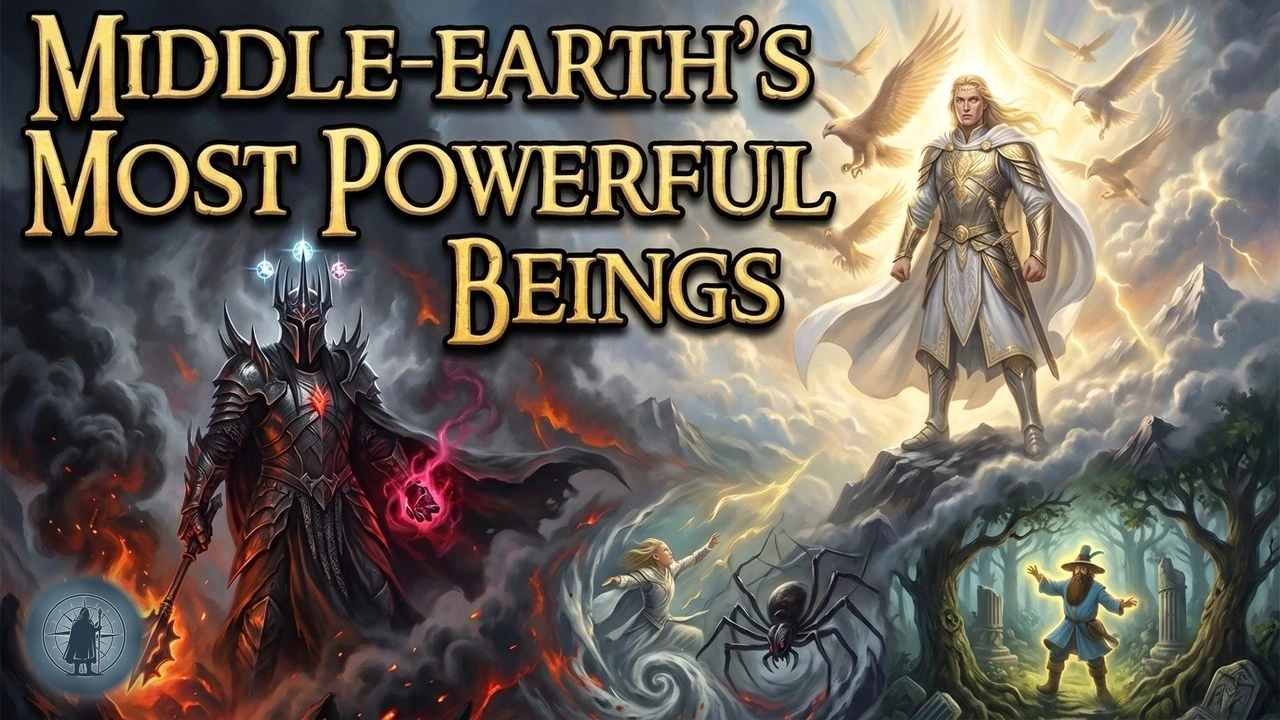
Middle-earth's Most Powerful Beings
 Watch the episode
Middle-earth's Most Powerful Beings | The Ranking Tolkien Refused
Watch the episode
Middle-earth's Most Powerful Beings | The Ranking Tolkien Refused
Main Narrative: The 10 Most Powerful Beings in Middle-earth
SECTION: Five Lists That Can't Agree on Anything
Welcome back to another episode of Ranger of the Realms. Today we're doing a big one. Who are the most powerful beings in Middle-earth? I'm going to try and do this honestly. I'm not trying to fan flames or bait anybody into engagement. But I think we're going to watch many arguments fall apart.
Let's start with what's already out there. Do a quick Google search and you'll find plenty of well-circulated published rankings of this exact question - SlashFilm, Fiction Horizon, MovieWeb, The Fantasy Review, and many others. If you look at five lists, you'll find a lot of disagreements.
Three of the ranking lists I mentioned open with Eru Ilúvatar at number one, and not one of those three spends a paragraph defending it. The Fantasy Review just seems to mention Eru in passing. And some lists don't include the creator of the universe at all.
Tom Bombadil is pretty much on everybody's list. We're all in agreement that Bombadil, along with beings like Sauron and Gandalf, belong on the list somewhere. Fiction Horizon puts Bombadil second - over Manwë, over Morgoth, over every god in the pantheon. Ungoliant, who once wrapped Morgoth in webs and came close to killing him, only appears once in all the lists I mentioned. Lúthien doesn't appear at all...which seems crazy. We did an entire episode about her resume, which makes a strong case that she could be the most powerful being to ever walk Middle-earth. Melian didn't appear on any of the quick lists I surveyed. Tulkas, who forced Melkor into submission with his bare hands, only made one list.
The disagreements grow when the field narrows. In the same year, ScreenRant published a ranked list of the Maiar with Melian fourth and Gandalf eighth. Collider took the same group and had Gandalf first and Melian eighth. They put Radagast and the two Blue Wizards above both Melian and Eönwë.
So what is everyone actually reading? Mostly the same handful of sentences.
Tolkien never built a system for this. There are no levels in Middle-earth, no stats, no ladder. What there is instead is a scatter of superlative phrases dropped into a couple of short texts at the front of The Silmarillion. They were never checked against each other or against anything that happens in the stories afterward. "The mightiest of those Ainur who came into the World." "Greatest in strength and deeds of prowess." "Wisest of the Maiar." Three sentences, three superlatives, three different qualities being measured, all sitting within a few pages of one another.
Try to stack them into an order and the order falls over. Because the stories continuously produce results the phrases can't explain. An Elf-king wounds a fallen god seven times and leaves him limping for the rest of his life. The most feared spirit of the Second Age loses a fight to a dog. The being explicitly named the mightiest thing ever created ends his career scarred, in constant pain, and too frightened to walk out his own front gate.
And there's a problem sitting at the very top of that totem pole that is rarely discussed. Eru Ilúvatar probably shouldn't be on this list. The Ainulindalë is specific about what makes a god a god in Tolkien, and strength has nothing to do with it. When the Ainur went down into the world, this happened to them: "this condition Ilúvatar made, or it is the necessity of their love, that their power should thenceforward be contained and bounded in the World, to be within it for ever, until it is complete, so that they are its life and it is theirs. And therefore they are named the Valar, the Powers of the World."
Entering the World is itself the limit. Every god in this story accepted a limit that Eru never took, and they're named after it. He set the rules and stayed outside them, which makes him the frame around the whole question rather than an entry inside it.
So that's the plan. I'll take the question seriously - and every time it breaks, we'll find out what broke it.
SECTION: The Only Ranking Tolkien Wrote
Ok. Let's get into it. Tolkien did write one formal hierarchy. Exactly one. And the most useful thing about it is who was left off.
There's a short passage in the Valaquenta naming the Aratar, the High Ones of Arda. Manwë and Varda, Ulmo, Yavanna and Aulë, Mandos, Nienna, and Oromë. Eight names. That's the whole thing.
So who isn't on it? Tulkas.
Tulkas is the being the same book calls "greatest in strength and deeds of prowess," and his record is one of the biggest single-handed feats below Eru anywhere in the legendarium. It happens twice.
The first time is before the world was even finished. Melkor and the other Valar were at war over the shape of Arda, and Tolkien is blunt about how that was going. "For long Melkor had the upper hand." He was winning. Then Tulkas arrived from outside the world, having heard in the far heaven that there was fighting going on, "and Arda was filled with the sound of his laughter." "Melkor fled before his wrath and his laughter, and forsook Arda, and there was peace for a long age."
Melkor walked away from the world rather than fight him. And Tulkas doesn't carry a weapon. The Valaquenta is specific: "his weapons are his hands."
The second time is the Battle of the Powers, around the year 1090 of the Trees, when the Valar finally came for Melkor in his fortress at Utumno. "Then Tulkas stood forth as champion of the Valar and wrestled with him, and cast him upon his face; and he was bound with the chain Angainor that Aulë had wrought, and led captive." Melkor spent the next three ages locked in the halls of Mandos because one tough Vala put him face-down in the dirt.
Two wins against the lord of darkness.
No weapons.
Just fists.
And Tolkien left him off his own top eight.
Tolkien gave us the reason in the Valaquenta, though. One sentence after the praise. "He has little heed for either the past or the future, and is of no avail as a counsellor, but is a hardy friend." The wording is no avail, not little avail. The strongest being in creation is worth nothing in the room where the decision gets made, and Tolkien's own hierarchy priced that at zero.
Which tells us what the Aratar actually measures, and it isn't force. It's how grand you are, your role, and how close you stand to what Eru wants. Fans have read it as a stat block for fifty years. It's a seating chart.
Manwë works the same way. Tolkien never once calls him the mightiest. He calls him "the noblest of the Ainur," "dearest to Ilúvatar," the one who "understands most clearly his purposes," "first of all Kings." Every superlative attached to the King of the World is about station, closeness to God, and moral standing. The strength superlative goes elsewhere, and it comes from the highest possible source. In the Ainulindalë, Eru says it himself: "Mighty are the Ainur, and mightiest among them is Melkor."
And then there's Eönwë, which is where this gets a little weird.
Nearly every tier list you'll read has Eönwë, Manwë's herald, somewhere near the top. This hangs on one clause from the published Valaquenta. Eönwë, it says, is the one "whose might in arms is surpassed by none in Arda." Which says flatly that a Maia outfights every god in existence.
Here's the rub. The Silmarillion we own was assembled by Christopher Tolkien out of his father's papers after he died. And in his own later commentary, Christopher mentions that the note on Eönwë was his own addition rather than his father's. It was written in to prepare readers for Eönwë taking command of the army that ends the First Age. It's canon as published. But the question is who wrote it, and the most-quoted power statement in all of Tolkien might be his editor's sentence.
And the Silmarillion undercuts the clause itself. After Morgoth falls, Sauron comes to Eönwë and repents, and Eönwë can't act: "it was not within the power of Eönwë to pardon those of his own order." His own order. Tolkien puts the two of them in the same category. So Eönwë tells him to sail to Valinor and take his judgement from Manwë. And Sauron ignores him. He just walks away, and nobody stops him.
SECTION: Power Is a Budget
Tolkien had a theory of strength. He wrote it down late in his life, in an essay about the motives of the villains in The Silmarillion. So this means the power ranking could change depending on when you ask the questions.
The idea is economic. What a being can do works like a budget rather than a possession. It gets spent, and the ledger runs one direction only.
Morgoth's story is a great example here. "To gain domination over Arda," Tolkien wrote, "Morgoth had let most of his being pass into the physical constituents of the Earth." He made a purchase. He wanted to own the matter of the world, and matter isn't for sale, so he paid with himself. And here's what it cost: "in this way Morgoth lost, or exchanged, or transmuted, the greater part of his original angelic powers, of mind and spirit, while gaining a terrible grip upon the physical world."
Then Tolkien sets Sauron beside him, in two lines. "Sauron's, relatively smaller, power was concentrated; Morgoth's vast power was disseminated. The whole of Middle-earth was Morgoth's Ring."
And this leads Tolkien to a conclusion that upends the usual order. "Sauron was greater, effectively, in the Second Age than Morgoth at the end of the First. Because, though he was far smaller by natural stature, he had not yet fallen so low."
The lieutenant outgrew the master by spending slower, not by growing stronger.
Breeding Orcs, making dragons, planting lies - all of it came with a cost.
The receipts are physical. In the wastes of Lammoth, in the year 1495 of the Trees, Ungoliant, who he thought was an ally, turns on him. Melkor escapes, flees to Angband and sets the stolen Silmarils into his iron crown. The jewels fight back: "his hands were burned black by the touch of those hallowed jewels, and black they remained ever after." He goes through the whole First Age in pain from the objects he stole, wearing them on his head, unable to take the crown off.
Then the year 456 of the First Age. Fingolfin rides alone to the gates of Angband and calls Morgoth out. "He wounded Morgoth with seven wounds, and seven times Morgoth gave a cry of anguish, whereat the hosts of Angband fell upon their faces in dismay." Morgoth eventually wins. He kills Fingolfin. And then the bill arrives.
"Morgoth went ever halt of one foot after that day, and the pain of his wounds could not be healed; and in his face was the scar that Thorondor made."
That limp? That's the receipt. An angelic spirit that hasn't overspent its power can shed a damaged body like an old coat and make itself another. Morgoth can't. He's stuck inside a wounded thing that hurts, permanently.
Sauron watched all this and decided to make the same trade for a fraction of the price. Writing to his publisher, Tolkien says Sauron "had been obliged to let a great part of his own inherent power pass into the One Ring." Inherent, meaning the part he actually ran on rather than something spare. He put a piece of himself into an object he could carry in a pocket. Morgoth put most of himself into a planet he could never pick up again. That's why the Ring could be undone in an afternoon at Mount Doom, and why the damage Morgoth did has never been undone at all.
Now the tricky part. Most power ranking discussions will avoid this part.
The whole power draining idea comes to Tolkien pretty late. It lives in essays he wrote after 1955, and it sits badly against the book he actually finished. Describing Morgoth around the year 455 of the First Age - long after the draining was well underway - the Silmarillion says this: "though his might was greatest of all things in this world, alone of the Valar he knew fear."
Greatest of all things in this world. At 455. Both halves of the argument in one sentence, and Tolkien never reconciled them. Christopher warned readers that they enter these late essays at their peril, because there they're watching his father dig at the rock-bottom base of his own invented world. So any ordering built entirely on this idea is built on the author's scratch paper.
SECTION: The King Who Had to Ask
So who can compete with Morgoth? Well Manwë sits third or fourth on almost every list. The reasoning always feels the same. He's the King, so he must be super strong. The good news is that the texts say something a little more interesting than that, but much less flattering.
Let's start with the sentence that explains his whole existence.
"For Manwë was free from evil and could not comprehend it, and he knew that in the beginning, in the thought of Ilúvatar, Melkor had been even as he; and he saw not to the depths of Melkor's heart, and did not perceive that all love had departed from him for ever."
Manwë is incapable of evil. In most stories that's a compliment. Here it's basically a security hole.
Melkor had been chained in Mandos for three ages. In the year 1400 of the Trees he asks for pardon. Nienna pleads for him, Mandos says nothing at all, and Manwë - who can't imagine what it feels like to lie - believes he's sorry, and lets him out.
What a mistake.
In 1495, Melkor and Ungoliant kill the Two Trees and put out the light of the world. Melkor murders Finwë, the High King of the Noldor, at his own door. He steals the Silmarils. The Noldor swear the Oath and go after him, and on the way out they kill their own kin at Alqualondë for their ships. Five centuries of war in Beleriand follow, and every death in it traces back to a pardon signed by the most virtuous being in creation.
Tolkien later worked out the mechanism, in a short essay on how minds contact each other in his world. What follows is a summary of his argument rather than a quotation. Every mind in Arda is naturally open, and any mind can close itself at will. Manwë never closed his mind. He felt he had nothing to hide and no reason to hide it. Melkor did close his mind. Permanently. And he kept it shut.
So Melkor could read Manwë whenever he wanted, and Manwë could never read Melkor at all. Transparency is often a virtue - but here - the most transparent being in Arda just turned out to be a king who was easy to lie to.
His authority is real, though. It just doesn't work the way people assume when they put him near the top.
The clearest case is Eärendil. A mortal man sailed to Valinor, which is forbidden. The standing decree from Mandos is that no mortal who sets foot in Aman may remain living. Manwë steps in and overrules it. "In this matter the power of doom is given to me." He can suspend a law of the universe, and nobody else in the story can do that.
And then he authorises the Host of the West, the army that finally finishes Morgoth. He doesn't lead it though - Eönwë does. The King of Arda declares the war and stays home.
The decisive case is Númenor, in the year 3319 of the Second Age. Ar-Pharazôn's armada is sailing west to take immortality by force. The response is one of the most remarkable sentences Tolkien ever wrote. "Then Manwë upon the Mountain called upon Ilúvatar, and for that time the Valar laid down their government of Arda."
They just quit.
Faced with a fleet of men, the entire pantheon resigns its office and hands the problem upward. Then Eru flexes and decideds to reshape the entire planet - he opens a chasm in the sea, bends the world, and takes Aman off the map for good. Tolkien confirmed the mechanism in his letters. Sauron, he wrote, "was first defeated by a miracle: a direct action of God the Creator, changing the fashion of the world, when appealed to by Manwë."
When appealed to by Manwë. The Elder King's biggest single act is asking someone else to do it.
And Tolkien knew exactly what he'd built. In the same late essay, grading his own gods: "The wiser they became the less power they had to do anything - save by counsel." That's the design. He built them that way on purpose.
SECTION: Nobody Was There
The title of this episode provides an important qualifier that some may miss. We're talking about the most powerful beings in Middle-earth.
In Middle-earth.
But many of the beings anyone puts in this type of list weren't there.
After Melkor threw down the two great Lamps and wrecked the first shape of the world, the Valar pulled back. They raised the Pelóri, a wall of mountains, along the eastern shore of Aman, and later sealed the passes and hid the road home entirely. That's the Hiding of Valinor. Tolkien's own verdict on it is harsh. It "came near to countering Morgoth's possessiveness by a rival possessiveness, setting up a private domain of light and bliss against one of darkness and domination."
Manwë's throne is on Taniquetil, the highest point in the world. He watches from it. He doesn't come down.
Count the times the Valar come into Middle-earth in force and the number is two. The Battle of the Powers, around the year 1090 of the Trees, when they came for Utumno. And the War of Wrath, roughly 545 to 587 of the First Age, when they came for Angband.
Fan arguments assume the opposite, but Tolkien never says any Vala personally fought in the War of Wrath. The Host of the West is led by Eönwë, and it's made up of the Vanyar and the Noldor who stayed in Aman. Late essays imply the Valar took direct action without ever specifying what. I've heard some say that Tulkas bound Morgoth again during the War of Wrath but Tolkien never wrote that.
So for most of the recorded history of the world, Middle-earth belongs to Melkor by default, and after him to Sauron. They didn't outfight anybody. All they had to do was show up.
There's one exception to this rule, though. Ulmo. The Valaquenta gives him an explicit placement - "he is next in might to Manwë," one of the only straight comparisons Tolkien ever wrote between two gods - and then it tells you what he did with it. "Ulmo loves both Elves and Men, and never abandoned them, not even when they lay under the wrath of the Valar."
Ulmo argued against the Hiding of Valinor. He lost the argument, then ignored the result. He worked inside Middle-earth without a break through the whole of the long dark. He put the vision of a hidden city into Turgon's mind, which became Gondolin. He sent Tuor there, and sent a warning to Nargothrond that nobody listened to. Number two in the pantheon, and the only top-tier being with a continuous presence in the continent this episode is supposedly about.
The mirror image of this is Morgoth, and the contradiction inside him is the whole problem in miniature. After Fingolfin's duel in 456, Melkor never passed through the gates of Angband again. Not once. For the next hundred and thirty years, everything he does, he does through Glaurung, the Balrogs, and armies of Orcs. His personal reach shrinks to one fortress in the far northwest - while his grip on the substance of the world keeps spreading, into every stone and every growing thing. He gets bigger and smaller at the same time.
And then there's what the Valar eventually settle on. Around the year 1000 of the Third Age, with Sauron stirring again, the response from Valinor is five old men. On foot. The Istari - the wizards, Gandalf and Saruman among them. Sent in bodies that could hunger and thirst and be killed, and specifically "forbidden to reveal themselves in forms of majesty, or to seek to rule the wills of Men or Elves by open display of power."
The Valar could still have come in force. But they'd decided that force was the wrong tool, and chose a delivery method built around the fact that they weren't coming themselves.
SECTION: The Two the Ladder Can't Hold
Now let's discuss two characters that make this exercise difficult in very different ways. It seems that Tolkien built both of them that way on purpose.
We've mentioned the first before. Melkor's accomplice in draining the trees. Ungoliant - a monstrous, spider-shaped spirit of unknown origin — not a Vala, not counted among the Maiar, not even confirmed to have come from the Music at all.
The Valaquenta names the significant Maiar - Ilmarë, Eönwë, Ossë, Uinen, Melian, Olórin who later becomes Gandalf, and the ones who went bad. Ungoliant isn't there. Every other spirit of her scale gets filed. But she doesn't.
The books don't even tell us where she came from.
"The Eldar knew not whence she came; but some have said that in ages long before she descended from the darkness that lies about Arda... But she had disowned her Master."
"Some have said."
That's a narrator admitting the record doesn't reach.
Ungoliant is almost unrankable because she performs a different type of operation entirely. Everything else in Tolkien's world makes things - the Ainur sing the world into shape, the Elves craft, and even Morgoth's evil is a corruption of making. Ungoliant subtracts. "She sucked up all light that she could find, and spun it forth again in dark nets of strangling gloom." What she makes is the Unlight, a darkness with weight to it, with "power to pierce the eye, and to enter heart and mind, and strangle the very will."
Then there was the incident in Lammoth. Morgoth has the Silmarils, Ungoliant wants them. Morgoth refuses. This refusal didn't go well for Morgoth. "The cry of Morgoth in that hour was the greatest and most dreadful that was ever heard in the northern world; the mightiest of the Valar cried aloud for aid." The Balrogs come boiling out of Angband with whips of fire and drive her off.
Put that picture in your head. What might be the most powerful being in Middle-earth, screaming for help, rescued by his own minions, from something the taxonomy has no word for.
Now the counter-argument. Ungoliant is ranked far too high on many of the tier lists that name her. Her peak only lasts one night. She needed Melkor to let her into Valinor, because she couldn't get in alone. She ran south the moment she met organised resistance and was never a factor again. She's a siege engine. Enormous while she's pointed at something, and helpless afterwards. Putting her above Manwë means we're grading one night's work. She's a one-hit wonder.
The second of the two beings I mentioned is Tom Bombadil. He challenges rankings from the opposite end.
Asked who he is, Goldberry gives two words.
"He is."
Asked whether the land belongs to him, she's careful. "No indeed! The trees and the grasses and all things growing or living in the land belong each to themselves. Tom Bombadil is the Master."
Tom Bombadil is an enigma.
There's the famous Ring scene... Tom takes the One Ring, holds it up to his eye and laughs. He puts it on his little finger and doesn't disappear, then hands it back to Frodo. Then Frodo puts it on and walks quietly away invisible - and Tom watches him the whole time. "Hey! Come Frodo, there! Where be you a-going? Old Tom Bombadil's not as blind as that yet."
The Council of Elrond also gives us another intriguing data point on Bombadil.
Erestor proposes sending the Ring to Bombadil for safekeeping, and four of the best-informed beings alive shoot it down. Gandalf goes first, and it's the second half of his answer that gets left out of every discussion. "Say rather that the Ring has no power over him. He is his own master. But he cannot alter the Ring itself, nor break its power over others." So the Ring has no grip on him, and he has none on it. And Gandalf keeps going: Bombadil "would be a most unsafe guardian; and that alone is answer enough."
Then Glorfindel, who puts a ceiling on him in one line. "In the end, if all else is conquered, Bombadil will fall, Last as he was First; and then Night will come." And it's Galdor, another elf in the room, who supplies the reasoning. "Power to defy our Enemy is not in him, unless such power is in the earth itself."
Tolkien agreed with his own characters. Writing to a reader in 1954, he put it flatly: "only the victory of the West will allow Bombadil to continue, or even to survive." And in the same letter, on why the man is impossible to place: "even in a mythical Age there must be some enigmas, as there always are. Tom Bombadil is one, intentionally."
Intentionally. Tolkien built him as a standing objection to exactly the kind of ranking this episode is discussing. Bombadil scores top marks on a scale he's declined to be measured on, which is why he turns up on most lists and why he probably doesn't belong on any of them.
SECTION: The One Thing Nobody in Arda Can Do
Tolkien wrote an essay on how minds talk to each other in Arda. It was called the Ósanwe-kenta. It sets a pretty hard ceiling over every being I mention in this episode.
Here's a quick summary, not a direct quote, because the essay is hard to come by. Every mind in Arda is naturally open. But any mind can also close itself to intrusion. Once closed, that barrier can't be broken. The mind becomes unwilling. Tolkien files it under the únati, the class of things that cannot be done at all.
And so this is pretty interesting. The harder you push, the harder it pushes back. Once the mind is closed, there's no amount of pressure that gets through, because pressure is the thing that thickens the wall. We know who tested this. Melkor did. The strongest being in the story, spending everything he had, couldn't open a mind that had said no.
So what do we think this does to a power ranking conversation built on strength?
The most valuable thing a Dark Lord could want is direct control of another will. And the universe is built to refuse it, permanently, to everybody. And this is why Sauron builds a ring.
The One Ring is a workaround for a limit he couldn't get past. He can't seize wills, so he has to buy them - nine rings to Men, seven to the Dwarves, one to bind the lot. And he pays for it out of himself. Tolkien's word, back in that letter, was obliged. There was no other route open.
The same ceiling shows up at the top of the story in a different form. Melkor's original crime was hunting through the empty places for the Flame Imperishable, the thing that makes made things alive. The Ainulindalë disposes of that whole project in eleven words: "Yet he found not the Fire, for it is with Ilúvatar."
Aulë proves it the gentler way. He builds the Seven Fathers of the Dwarves in secret, out of impatience and love. Eru catches him, and the verdict isn't anger. The creatures of Aulë's hand and mind, Eru tells him, "can live only by that being, moving when thou thinkest to move them, and if thy thought be elsewhere, standing idle." The greatest craftsman among the gods could build seven bodies and couldn't put a will inside one. They were puppets until Eru adopted them.
So there are two things nobody can do. Nobody below Eru can make a mind, and nobody at all, including Eru by his own choice, can force one.
Everything in this episode has been pressing against that. Morgoth spent himself into the rock trying to own matter, because he could never own minds. Sauron distilled himself into jewellery for the same reason. And Tolkien wrote down what would have happened if the good side had simply won by force. "If Gandalf had been the victor it would have been far worse than Sauron winning. The righteous Gandalf would have become self-righteous, ruling and ordering things for good until he had made good detestable and seem evil."
Winning the top spot, in Tolkien's world, is a way of losing it.
Which brings us back to the typical rankings we read about, and to one entry that occassionally comes up and reads like a joke.
Samwise Gamgee.
Sometimes listed above Elrond. On a list with Sauron at the top and a Balrog just ahead of Sam.
On any strength scale that seems indefensible. It's easy to laugh at. But Tolkien's own hierarchy has always ranked by what a being wants and what it's willing to give up. It is never a hierarchy ranked by force. Which is how a gardener who carried his friend up a mountain, wanted nothing at all, and handed the Ring back the moment it was asked for, might be one of the most honest entries on any of the lists.
So here's where this leaves us. I didn't want to make this episode centered around the traditional "Who's the most powerful?" list. We don't even know whether the most-quoted power line in Tolkien was written by Tolkien. We don't really know whether a single god swung a weapon in the war that ended the First Age. We don't know whether the idea this whole reordering rests on is canon or a draft he walked away from. Tolkien had every chance to settle any of it, and he went out of his way not to. He called his one unrankable character an enigma, intentionally. He gave the strongest being in his world two victories over the devil, and then left him off the High Ones entirely.
Which leaves an open question coming out of this discussion, and it isn't who would win.
What does power really mean in Tolkien's legendarium?