Transcript
Gandalf's Ring of Power
 Watch the episode
Gandalf's Ring of Power
SECTION: Servant or Master? The Line Tolkien Revised
"I am a servant of the Secret Fire, wielder of the flame of Anor."
Fourteen words, spoken in the dark under a mountain on the fifteenth of January in the year thirty nineteen of the Third Age. They may be the most quoted words Gandalf ever says, and seventy years later, people are still arguing about what they actually mean.
The version of this most of us hear isn't quite the one Tolkien wrote. In the book the phrase is "You cannot pass." Not "you shall not pass" - that one comes from the 2001 film. Small difference, and maybe we are overthinking here, but it matters and changes the posture of the scene. "Shall not" is an order. "Cannot" is a report. Gandalf is telling the Balrog that crossing simply isn't available to it. He says it four times before the bridge goes down, and the famous declaration isn't the climax of the speech at all. It lands immediately after the first "You cannot pass," as the reason for it.
Let's get technical for a moment and look at what Gandalf said. Two clauses. Two different verbs. Gandalf is a servant of the first thing. He's a wielder of the second.
Those aren't interchangeable. A servant belongs to something above him that isn't his and never will be. A wielder picks something up and puts it to work. If the Secret Fire and the flame of Anor were the same item, Tolkien would have given Gandalf one relationship to it, not two opposite ones inside a few words. The grammar is already telling us there are two separate things in that sentence, and only one of them is in his hand.
There's a draft that makes this clearer. Before the published version existed, Tolkien wrote the speech a different way, and Christopher Tolkien printed it decades later out of his father's papers. In that early version Gandalf gives himself a rank he doesn't have in the finished book:
"I am the master of the White Fire. The red flame cannot come this way."
In a later draft, the wording shifts again - "I am the master of White Flame" - but the rank holds both times. In the drafts, Gandalf outranks the thing he's carrying. In the published book Tolkien takes that away from him. He demotes the master to a servant, and he does it in probably the most important speech the character ever gets.
The color scheme flips too, which is going to matter by the end. In the draft, the white blaze is Gandalf's, and the red one belongs to the thing at the other end of the bridge.
And there's one more line in those papers worth knowing about, because it appears that Tolkien struck it out right after he wrote it. His first instinct was to have Gandalf justify himself by precedent. The deleted line says something like this: it is forbidden for any Balrog to come beneath the sky since Fionwë son of Manwë overthrew Thangorodrim. That's kind of a legal argument. Case law, being shouted at a demon in a tunnel. Tolkien ended up cutting it and put in its place a statement about who Gandalf belongs to.
There's one gap in the record before we go on. The words "Secret Fire," "Anor" and "Udûn" don't appear anywhere in that volume of drafts. The final wording arrived later, and as far as anyone has been able to establish, Christopher Tolkien never identified the moment it showed up. So the most famous sentence in the book doesn't have a birthday. We know exactly what it replaced, but we have no idea when he wrote it.
What we can do is take it apart. So let's give it a try and dig in.
SECTION: Who Made Narya, and Who Carried It
So why bring up Gandalf's ring at all right now? Well, in the scene we are talking about, there is a physical object in this scene, and hardly anybody in Moria knows it's there.
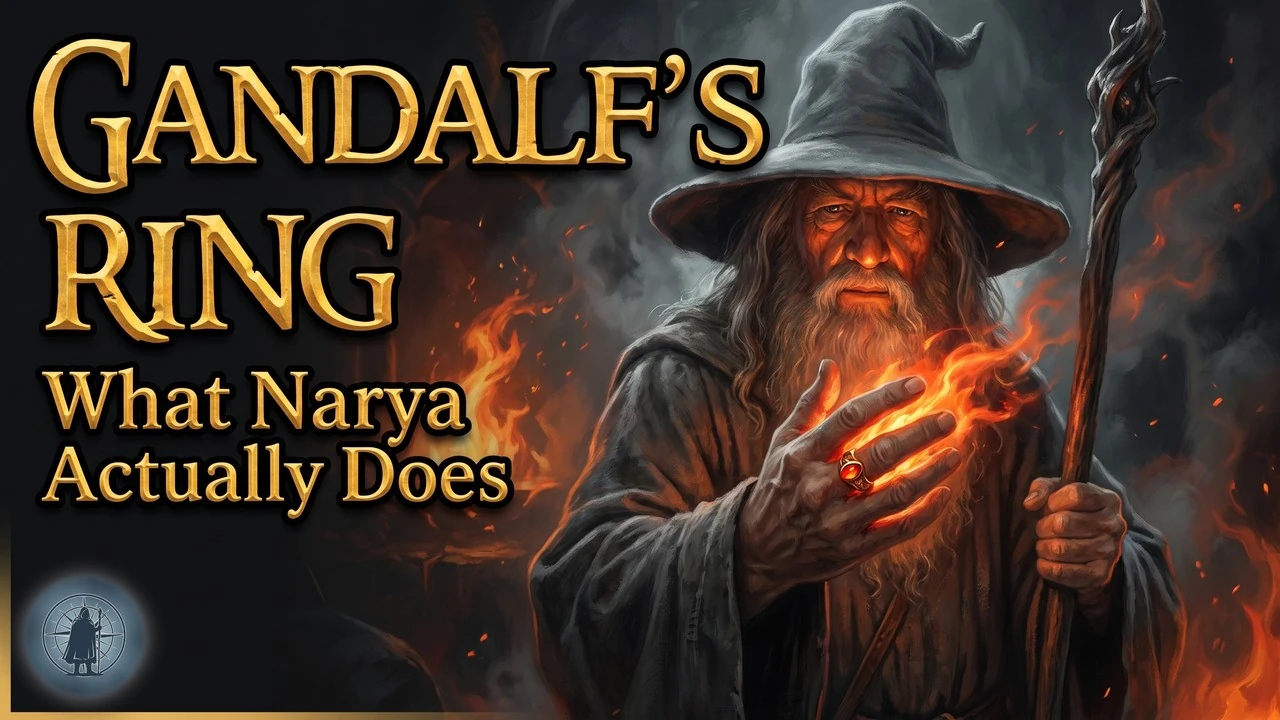
On Gandalf's hand, invisible to those who lack sight into the Unseen Realm, is a ring. Narya, the Ring of Fire, one of the Three the Elves made for themselves. It's a manufactured item with a date of manufacture, a named maker, a chain of owners, and some very fine print in the paperwork.
Narya was forged around the year fifteen ninety of the Second Age, in the Elven city of Ost-in-Edhil, in the country of Eregion. The smith was Celebrimbor, grandson of Fëanor, and he made the Three by himself. Sauron had been living among those smiths for centuries under a false name, teaching them, and he had his hands on every other ring that came out of that forge. Not these rings, though. The Silmarillion tells us: "the Three remained unsullied, for they were forged by Celebrimbor alone, and the hand of Sauron had never touched them."
And then, it adds the catch:
"yet they also were subject to the One."
That's the design flaw nobody could engineer out. Tolkien tells us in a letter from 1954 - the Three were unsullied because Sauron never made them and never touched them, but they were "partly products of his instruction, and ultimately under the control of the One."
Around sixteen hundred of the Second Age Sauron finished the One Ring in Orodruin, and Celebrimbor felt it the moment Sauron put it on. At that point, The Three rings came off and went into hiding. In sixteen ninety-three the War of the Elves and Sauron started, and from that year the Three were handed to the Wise, who "concealed them and never again used them openly while Sauron kept the Ruling Ring." Four years later Eregion was burned to the ground and Celebrimbor was killed. He never found out what his Ring of Fire would end up doing, or who'd be carrying it.
From here, the paperwork gets messy. The Silmarillion gives us one possibility: Celebrimbor hands Narya and Vilya to Gil-galad, the High King, and Gil-galad passes Narya on to Círdan the Shipwright at the Grey Havens. But in Unfinished Tales, inside a single essay, Tolkien contradicts himself. One passage has Celebrimbor giving Narya straight to Círdan at the outset. Another has Gil-galad keeping it himself and only handing it over when he marched south for the War of the Last Alliance. Tolkien never reconciled those two accounts, and there's no way to settle it now. Picking one is just a matter of preference rather than a finding.
What's not in doubt is where Narya ends up. Around the year one thousand of the Third Age, five wizards came across the sea into Middle-earth. Círdan met Gandalf on the dock at Mithlond and gave him a Ring of Power on the day he landed, before anybody else in Middle-earth had even got to know him.
From there, Gandalf carried Narya for over two thousand years.
That number is important, because of what goes with it. In the entire narrative of The Lord of the Rings - three volumes, a thousand pages - Narya is only named once. It's in the last chapter, at the Grey Havens, on the twenty-ninth of September in the year thirty twenty-one, and Tolkien slips one small word into that sentence. Frodo looks over and sees "that Gandalf now wore openly on his hand the Third Ring, Narya the Great, and the stone upon it was as red as fire."
That's the text admitting, in a single adverb, that for two thousand and twenty-one years it had never once been worn that way.
So we have the object. What we don't have yet is any idea what it's for.
SECTION: Círdan's Gift and the Only Promise Narya Gets
Everything anyone knows about what Narya does comes from one short speech, by one Elf, on one morning, and that Elf never explains himself again.
Círdan says this:
"Take this ring, Master, for your labours will be heavy; but it will support you in the weariness that you have taken upon yourself. For this is the Ring of Fire, and with it you may rekindle hearts in a world that grows chill."
That's it. That's the entire owner's manual.
Two functions are promised. Both of them are defensive, and both of them are psychological. The ring will hold Gandalf up when he's worn out. And it will let him start something burning again in other people when they've gone cold. There's nothing in that speech about strength, nothing about combat, nothing about light or heat or blasting anything at all. Círdan hands a Ring of Power to a stranger and describes it, basically, as a remedy for exhaustion and despair.
That lines up exactly with what the Three were built for in the first place. The Silmarillion says the keepers of those rings "could ward off the decays of time and postpone the weariness of the world." Tolkien, writing to his publisher in 1951, described the whole category the same way: the chief power of all the rings was "the prevention or slowing of decay," the preservation of what's loved, or at least of its appearance. These were a way of holding the door shut against time.
Elrond confirms this independently, decades later, in his own house, and he's obviously irritated to be saying it out loud at all. "They were not made as weapons of war or conquest," he tells the Council. "That is not their power. Those who made them did not desire strength or domination or hoarded wealth, but understanding, making, and healing, to preserve all things unstained."
So we've got the maker's intent, the keeper's description, and an independent confirmation from the one other person in Middle-earth holding a comparable ring. All three agree, and none of them describes anything you could point at an enemy.
Which raises the obvious question about Círdan. Why hand a thing like that to a man who just arrived in Middle-earth for the first time?
Tolkien sort of tells us:
"Círdan saw further and deeper than any other in Middle-earth."
That's an outright statement about his judgment. And what Círdan saw, in the newcomer who arrived last and looked least impressive of the five, was "the greatest spirit and the wisest." He backed that read with a Ring of Power and then went back to his shipyard for two thousand years without mentioning the gift to anybody.
The gift also fits Gandalf's job description. The wizards came with a hard limit on them. They were sent to contest Sauron and to unite the people who'd resist him, but they were "forbidden to match his power with power, or to seek to dominate Elves or Men by force and fear." Anything that made Gandalf stronger in a fight would have broken the one rule he was sent under. A ring that props him up when he's tired and helps him talk somebody out of giving up is precisely the sort of help an Istar could accept without breaking his mandate. Círdan picked the right person and the only tool that person was allowed to take.
The gift didn't come without consequence, though. Saruman was the head of the order, the White Messenger, the one "skilled to uncover all secrets," and he found out about the gift. He "begrudged it," Tolkien writes, "and it was the beginning of the hidden ill-will that he bore to the Grey."
So the epic rivalry that ends with Isengard tearing up Rohan starts with jealousy. Saruman didn't like seeing a pretty piece of Elven jewelry going to somebody else.
SECTION: The Flame Imperishable: What Melkor Never Found
Now let's shift to the other half of the sentence. A kind of burning that can't be picked up, bottled, or handed to anybody.
When Gandalf calls himself a servant of the Secret Fire, he's naming something that exists in Tolkien's world as a category rather than a thing. And Tolkien left a definition here. It's tucked into a note he wrote alongside one of his late philosophical dialogues, and it's about as clear as he ever got on any of this. The Flame Imperishable, he says, "appears to mean the Creative activity of Eru... by which things could be given a 'real' and independent (though derivative and created) existence."
It isn't heat or light, and it isn't courage or morale or inspiration - it's the power to make something that is, to hand a thing its own existence and then let go of it. In Tolkien's cosmology that power belongs to one being. That power isn't for sale.
We know it's not for sale because somebody tried to buy it.
In the Ainulindalë, before the world exists, Melkor goes hunting.
"He had gone often alone into the void places seeking the Imperishable Flame; for desire grew hot within him to bring into Being things of his own."
He wanted to create, not merely arrange. But Tolkien closes the door on that idea:
"Yet he found not the Fire, for it is with Ilúvatar."
The most powerful created being who had ever existed searched the emptiness outside the world for the ability to create, and it wasn't findable, because it isn't a substance lying around somewhere waiting to be collected. That one sentence rules out every reading in which anybody - Gandalf included - picks up the Secret Fire and uses it.
There's a second reason Gandalf can't be claiming to hold it, and it's probably a better one. He's made of it. When Ilúvatar first speaks to the Ainur, the spirits who'd sing the world into being, he says: "since I have kindled you with the Flame Imperishable, ye shall show forth your powers." Gandalf is one of those spirits. Olórin, a Maia, was in the room for that. So, "I am a servant of the Secret Fire", is a statement about what he's made of, said out loud to another spirit who was lit the same way but chose a different path.
That's to briefly acknowledge a claim we'll frequently run into when discussing the Secret Fire: that Tolkien confirmed the Secret Fire is the Holy Spirit.
The claim has a real source. A man named Clyde Kilby spent the summer of 1966 in Oxford, seeing Tolkien two or three times a week while helping him with the Silmarillion papers. Ten years later, in 1976 - three years after Tolkien had died - Kilby published a short memoir of those conversations. In it he writes: "Very specifically he told me that the 'Secret Fire sent to burn at the heart of the World' in the beginning was the Holy Spirit."
So the claim surfaces in a report of a private remark, written down a decade after it was made, by the only person present. That counts for something. But it isn't a citation. No numbered letter in Tolkien's published correspondence has been found to contain either "Secret Fire" or "Flame Imperishable," so as far as anyone has established, the identification isn't anywhere in his own writing.
But the sentence Kilby quotes back is real, and it's checkable. It's the opening paragraph of the Valaquenta:
"Therefore Ilúvatar gave to their vision Being, and set it amid the Void, and the Secret Fire was sent to burn at the heart of the World; and it was called Eä."
As far as I can tell, that's the only place the phrase appears capitalized in the published Silmarillion. Once, in the whole book.
And there's a second piece of evidence, older and firmer than Kilby's. Around 1915, as a very young man, Tolkien was compiling his first invented dictionary. One entry is the word Sā - "fire, especially in temples" - and beside it, in his own hand, he wrote the gloss: "a mystic name identified with the Holy Ghost."
Fifty years before that conversation in Oxford, in a private notebook nobody was meant to read, Tolkien was already making the same connection. Which tells us the association was genuinely his, and had been from the start. So it is interesting, but this doesn't make it a doctrine that Tolkien published under his own name, so I'll leave it at that.
SECTION: Arien, the Balrogs, and the Two Fates of Fire
Alright.
So the first half of the sentence points at something uncreated and untouchable. The second half points somewhere very different.
"Wielder of the flame of Anor."
Anor is Sindarin for the Sun. It's sitting inside place names all over the map. Minas Anor, the Tower of the Sun, later renamed Minas Tirith. Anórien, "Sunlending" - the land Minas Tirith itself stands in, and the ground Gandalf will be standing on less than two months from this moment, when he rides through the gates of that city on the ninth of March. When he says Anor in a tunnel under Moria, he's naming the Sun.
In Tolkien's world, though, the Sun has a biography, and a driver.
After Melkor and Ungoliant poisoned the Two Trees of Valinor, the golden tree Laurelin managed one last fruit before it died. The Valar took that fruit, and the smiths of Aulë built a vessel to carry it, and they needed someone to steer it across the sky. The one they chose was Arien, a spirit of fire - and the Silmarillion is very specific about her credentials. Before the world had a Sun at all she had tended the golden flowers in the gardens of Vána, and she was a spirit "whom Melkor had not deceived nor drawn to his service." Melkor was afraid of her, and once she was up there with the last fruit of Laurelin he never dared come near her.
Now, what's standing at the other end of that bridge?
A Balrog. And a Balrog, in Tolkien's own Quenya, is a Valarauko - the Valaraukar, "the scourges of fire," described in the Valaquenta as Maiar who went over to Melkor in the beginning of the world.
Which means Durin's Bane is older than the thing Gandalf is invoking against it. The Balrogs were corrupted back in the dark, in the ages when there was no Sun yet for anybody to be corrupted under. Arien was given her vessel far later, after the Trees were already dead. The fallen spirits came first. The answer to them had to be built.
Arien is a fire-spirit Melkor couldn't turn. Durin's Bane is a fire-spirit Melkor turned.
They are the same kind of being.
Gandalf is naming two outcomes that were available to spirits of one order - one stayed, one went - and he's doing it as a third spirit of that same order, standing in the middle, announcing which column he's in. Olórin was kindled from the same source as the Balrog in front of him. The only difference between them is a choice made before the world was shaped.
And the second half of the antithesis nails it down. "The dark fire will not avail you, flame of Udûn." Udûn is Sindarin for Utumno, which was Melkor's first fortress, dug under the far north before the Sun or Moon existed.
We've done an episode on Utumno, so if you want more of the backstory there, be sure to listen.
So the contrast Gandalf draws is geographic as well as moral. The Sun against Utumno. The thing that rides above the world against the thing that was hollowed out underneath it.
That name didn't die out, either. Thousands of years later, Sauron named a valley inside Mordor Udûn - the ground between the Black Gate and the Isenmouthe - in memory of his old master's stronghold. Frodo and Sam walk through it in the last book. The word was still in working use, attached to a real place.
A final thing before we wrap this part of the discussion. Something to consider...
Anor, the Sun, and Narya, the ring, come down from the same primitive root in Tolkien's invented language family - NAR, meaning fire. Gandalf's ring and the Sun are etymological cousins. That's a real connection, in Tolkien's own philology, and it's exactly why the popular reading of this line is so tempting. It deserves an answer rather than a shrug. We'll see if we can give it one.
SECTION: The Spell of Shutting That Nearly Broke Gandalf
Before any of that, though, there's a test that any theory about Gandalf's power has to survive. The book does give it to us.
On the fifteenth of January, in the year thirty nineteen, the Fellowship is trapped in the Chamber of Mazarbul - the room with Balin's tomb in it. Orcs are coming. Gandalf goes to the door alone and tries to seal it, and afterwards he tells the others what happened, in the most revealing speech he gives in the entire book.
"I could think of nothing to do but to try and put a shutting-spell on the door. I know many; but to do things of that kind rightly requires time, and even then the door can be broken by strength."
There's a lot in that sentence.
Shutting-spells are a category. Plural. A body of technique Gandalf has learned, the way somebody learns a craft or medicine. Doing one properly takes time, and time is what he hasn't got. And even done properly, the thing has a failure mode: enough brute strength will break it anyway.
Then it gets worse. He hears the orcs on the far side shouting one word he can make out, and it's the last word anybody in that room wants to hear.
"All I caught was ghâsh: that is 'fire'."
The orcs are chanting it seconds before a fire-demon walks in. Tolkien puts the same concept into three languages inside two pages - ghâsh in the Black Speech, naur in Sindarin, Anor over the bridge - and lets us connect the dots ourselves.
And then something takes hold of the iron ring on the other side.
"What it was I cannot guess, but I have never felt such a challenge. The counter-spell was terrible. It nearly broke me. For an instant the door left my control and began to open! I had to speak a word of Command. That proved too great a strain. The door burst in pieces."
He lost.
The wielder of the flame of Anor gets into a contest of spell against counter-spell with the Balrog, through a closed door, and the door blows apart and throws him down the stairs. When the others find him he says, "I have met my match, and have nearly been destroyed." And a little later: "Ah! I have never felt so spent, but it is passing."
That's the man who, less than an hour from now, will say the most confident sentence in the book.
The rest of the evidence we have all points in the same direction. On Caradhras, freezing, with wet wood, Gandalf refuses to light a fire until there's no choice left - "at last reluctantly Gandalf himself took a hand" - and then he does it in Sindarin, naur an edraith ammen, roughly "fire be for the saving of us." Which is a request, by the way. And the instant the wood catches, he tells everybody what it cost:
"If there are any to see, then I at least am revealed to them. I have written Gandalf is here in signs that all can read from Rivendell to the mouths of Anduin."
He's not really supposed to use magic.
Lighting a campfire gives away his position across half a continent.
Even Gandalf's beloved fireworks fit into this discussion. Back in The Hobbit, when Gandalf sets pine-cones alight over the wolves - one burning blue, one red, one green - Tolkien's narrator explains where that came from in a single aside: "Gandalf had made a special study of bewitchments with fire and lights." A study. Something he worked at, years before anybody handed him anything on a dock in Mithlond.
Tolkien classified all of this himself. Writing in 1954 about how magic works in his world, he said that "Elves and Gandalf sparingly used" it for real results, "for specific beneficent purposes" - and the one worked example he reached for, out of everything in the trilogy, was the campfire on Caradhras. That's his own headline case for what Gandalf's power is: small, careful, useful, and rationed.
SECTION: Is the Flame of Anor Really Gandalf's Ring?
So the big question:
is the flame of Anor Narya?
It's the answer most of us land on first, and the case for it is decent. Let's pressure test it before taking it apart.
The stone is right. Frodo's description at the Havens is "the stone upon it was as red as fire." Círdan's own name for the object is the Ring of Fire. Gandalf had been carrying it for 2,019 years by the night he stood on that bridge, which makes it the longest-held possession of his life. Based on his actions, he's the fire-wizard of the Third Age: the fireworks at Bilbo's party, the burning pine-cones in The Hobbit, the blaze on Caradhras, the tree that goes up "in a leaf and bloom of blinding flame" against the wolves. And Narya and Anor descend from the same root. If you're building that case from scratch, you'd feel good about it.
So what further evidence do we need?
First, the secrecy, which is the objection that does most of the damage. The Silmarillion says: "the Red Ring remained hidden until the end, and none save Elrond and Galadriel and Círdan knew to whom it had been committed." Three people. In the world. Not the White Council - Saruman found out by digging, and resented it. Elrond won't even discuss the Three at his own Council in his own house: "of them it is not permitted to speak."
For the Narya reading to work, Gandalf has to break two millennia of that discipline by announcing his ring to a servant of Sauron.
Second, the mandate. The wizards were "forbidden to match his power with power." A ring that amplifies Gandalf in single combat is precisely the thing he spent two thousand years refusing to do.
Third, Elrond's flat statement about what the Three are: "not made as weapons of war or conquest: that is not their power." Narya's stated function, from the only person who ever described it, is support in weariness and the rekindling of hearts. Neither of those helps anybody on a bridge.
Fourth, and this one's almost silly. In the earliest draft of the speech, the red flame is the enemy's. "I am the master of the White Fire. The red flame cannot come this way." Tolkien's first color scheme puts red on the wrong side entirely for a red-stoned ring.
And fifth, the grammar we started with. No created being can wield what belongs to Eru alone, and Melkor proved that in the Void. So the "wielder" clause has to land on something created, something with a maker and a history behind it. Sunlight has both.
There's a limit on all of this, though. Tolkien never explained "flame of Anor." Every reading of that phrase, including the one just laid out, is inference. What can be said is that the reading pointing at the Sun is backed up by the text, and the one pointing at the ring has to argue with five separate passages.
I guess the answer is less important here.
The ring was there the whole time. It was on Gandalf's hand in the Chamber of Mazarbul when the counter-spell nearly broke him, and it did nothing. It was on his hand on the bridge, and the text credits it with nothing there either. Then, in October of the year thirty eighteen, at a table in Rivendell, Gandalf listens to Elrond say that when the One is destroyed the Three may fail and "many fair things will fade and be forgotten" - and votes to destroy it anyway, with the Ring of Fire on his finger. An object built to slow the world's decay, carried by the one person alive whose success will end the age it was made to preserve.
Where Narya actually works, if it works anywhere, is a room in Rohan on the second of March, where an old king who has stopped believing in himself is told:
"Your fingers would remember their old strength better, if they grasped a sword-hilt."
Denethor is the control case. A Steward with a seeing-stone, no ring, and nobody going room to room to argue him out of the dark. He ends his life on a burning pile of wood.
I'm not sure the loud fire in Moria was ever the ring. The ring's work was probably the quiet thing that leaves no mark in the record, in the war Tolkien actually shows us over and over again: the war against people giving up. And a ring against despair, working perfectly, would look exactly like this.
It would look like nothing at all.